
The Complete Guide to IT Engineers in Kyoto: Salaries, Career Changes, Work Styles, and Communities (2026 Edition)
Key points
- The market for IT engineers in Kyoto emphasizes quality over quantity: distinctive companies are concentrated here, and communities are dense.
- Salary: no range is stated here, because we have no published figures whose source and aggregation conditions we can verify.
- Major companies fall into four categories: established technology companies, internet companies, contract development and systems integrators, and startups.
- Miyako de IT holds study groups and mokumoku sessions roughly once or twice each month.
- Work environments are plentiful, including KOIN and UNKNOWN KYOTO; temples and machiya townhouses also function as hubs.
- This article was organized by Miyako de IT, which has 7 years of operations, more than 647 members, and more than 164 events.
People working as IT engineers in Kyoto are more likely than their counterparts in Tokyo or Osaka to encounter a lack of consolidated information. Company lists exist, but study groups, communities, work environments, salaries, career changes, and work styles are discussed separately, making the whole picture difficult to grasp.
This page organizes the information needed to work, change jobs, and learn as an IT engineer in Kyoto. It is the 2026 edition of a complete guide to Kyoto's IT engineering landscape, compiled from the perspective of Miyako de IT, which has operated an IT engineer community in Kyoto since 2019 and is run by Netsujo Inc..
This article is an entry point to the whole picture. Dedicated articles examine each subject in greater depth: see The Complete Guide to IT Engineer Salaries in Kyoto for salaries, 20 IT Companies with Headquarters or Offices in Kyoto for companies, and Changing Jobs as an Engineer in Kyoto for the career-change process.
---
Characteristics of Kyoto's IT industry
Kyoto's IT industry has characteristics that distinguish it from other cities. First, although Kyoto has fewer companies than Tokyo, it has many distinctive ones. Long-established technology companies including Nintendo, Hatena, Kyocera, SCREEN, and OMRON are concentrated here. Kyoto also has a certain number of startups, but this is a market of quality rather than quantity. Second, universities are close at hand. Kyoto University—with its Department of Informatics and Mathematical Science in the Faculty of Engineering and Graduate School of Informatics—and Kyoto Institute of Technology—with its Information Science course—are in Kyoto City. Doshisha University's information-related faculties, the Faculty of Science and Engineering and Faculty of Culture and Information Science, are in Kyotanabe, Kyoto Prefecture. Ritsumeikan University's College of Information Science and Engineering moved to Osaka Ibaraki Campus in April 2024. This environment allows an academic atmosphere to flow readily into IT practice. For more detail, see Why Kyoto Needs IT Engineer Communities for Academia–Industry Collaboration. Third, study groups and meetups run continuously. We have no comparative data against other cities, so we do not claim there are more of them; what we can say is that they continue at a scale where participants recognize one another. Miyako de IT's history alone lists more than 164 events in its archive. Kyoto's IT Engineer Landscape examines the structure of Kyoto's IT industry and the background to why the city needs an IT engineer community.---
Major categories of IT companies in Kyoto
IT companies in Kyoto can be divided broadly into four categories. 1. Established technology companies: Nintendo in Minami Ward, Kyoto; Kyocera in Fushimi Ward; SCREEN Holdings in Kamigyo Ward; OMRON in Shimogyo Ward; Murata Manufacturing in Nagaokakyo, Kyoto Prefecture; and Nidec in Minami Ward, among others. They have a global presence in hardware, games, and precision technology. Competition is relatively high for both graduate and mid-career hiring. 2. Internet companies: Hatena—founded in Kyoto in 2001 and based in Nakagyo Ward—is a representative example. These Kyoto-born companies focus on web services and application development. Many Tokyo-headquartered companies also have branches or offices in Kyoto. 3. Contract and systems development: Kyoto has many small and medium-sized contract-development companies, systems integrators, and web-production companies. Their work ranges from digital-transformation support for local companies to subcontracting for companies in Tokyo. 4. Startups and ventures: Startups operate across diverse fields including fintech, AI, blockchain, tourism technology, education technology, and climate technology. They have small teams but often pursue distinctive businesses.For a detailed company list, see IT Companies in Kyoto.
---
Salary levels for IT engineers in Kyoto
Salaries for IT engineers in Kyoto vary substantially with company size, role, and years of experience. Ranges by years of experience or by role are not published here, because we have not been able to obtain figures whose source and aggregation conditions we can verify.
A comparison with Tokyo has the same problem: it is only meaningful using the same survey, the same role classification, and the same year, so no fixed percentage difference is stated. If living costs are part of the comparison, the expenditure side has to be drawn from equally consistent data. Working fully remotely for a Tokyo company while living in Kyoto is also an available option.
The Complete Guide to IT Engineer Salaries in Kyoto explains how to read salary figures and what to check in a job description.---
The career-change market for IT engineers in Kyoto
From the perspective of changing jobs as an IT engineer in Kyoto, there are three strategies:
- Target companies headquartered or based in Kyoto: Established companies such as Nintendo, Hatena, and Kyocera, or Kyoto startups. The choice depends on whether you value stability or a distinctive business.
- Secure a fully remote position with a Tokyo company: The shortest route to living in Kyoto while maintaining salary levels. Demand is especially strong for Go, TypeScript, Rust, and AI engineers.
- Move from contract development or systems integration to a product company: If you want to shift the axis of your career, target fields where Kyoto has a high density of product-company openings.
When changing jobs, assess not only salary and benefits but also whether it is an environment in which you can continue living in Kyoto. Commute time, meeting structures, required office frequency, trips to Tokyo, and room to participate in communities all affect long-term satisfaction.
---
Career paths for IT engineers in Kyoto
In addition to the standard metropolitan career path—individual contributor to technical lead, engineering manager, and CTO—the career paths of IT engineers in Kyoto include locally distinctive developments.
- Deepen as an individual contributor: Build focused expertise that is valuable nationally and globally.
- Become a locally rooted practitioner: Specialize in Kyoto-specific issues through digital-transformation support, academia–industry collaboration, or public-sector IT.
- Hold multiple jobs or become independent: Lower land prices and living costs than Tokyo make the risk of independence easier to take.
- Operate communities or educate: Move into developing others within a dense engineer community.
---
Choosing communities and study groups
Kyoto has several engineer communities. There are four axes for choosing among them.
1. Technology-specific or general: A study group focused on a specific language or framework allows deep learning, while a general community more readily broadens peer connections. 2. Primarily in person or online: The choice depends on whether you value face-to-face relationships or want to participate without being tied to a location. 3. Scale: A group of around 10 offers density, while one of around 100 offers more stimulation. Choose according to your current phase. 4. Years of continuity: New communities tend to foreground participants' energy, while long-running communities have accumulated networks. Miyako de IT occupies the position of a general, primarily offline community of 20–30 people, with 7 years of continuity and more than 647 members. Compare it with other communities in 15 IT Engineer Communities. If you are attending for the first time, also see For First-Time Participants. If you are just beginning to learn programming, How to Learn Programming in Kyoto explains how to choose among self-study, schools, and study groups.---
Work environments and coworking
Kyoto offers many options for securing a place for remote work or other tasks.
- KOIN in Kyoto Economic Center: Kyoto's innovation hub, with startup-support functions
- UNKNOWN KYOTO: Coworking with accommodation in a 100-year-old building in Kiyomizu-Gojo
- SHARE LOUNGE Kyoto Tsutaya Books: A lounge-style workspace with free drinks
- .andwork kyoto: A hotel-based workplace in Kawaramachi
- Taisho University Kyoto Academia: A university facility that can also host study groups; see the report
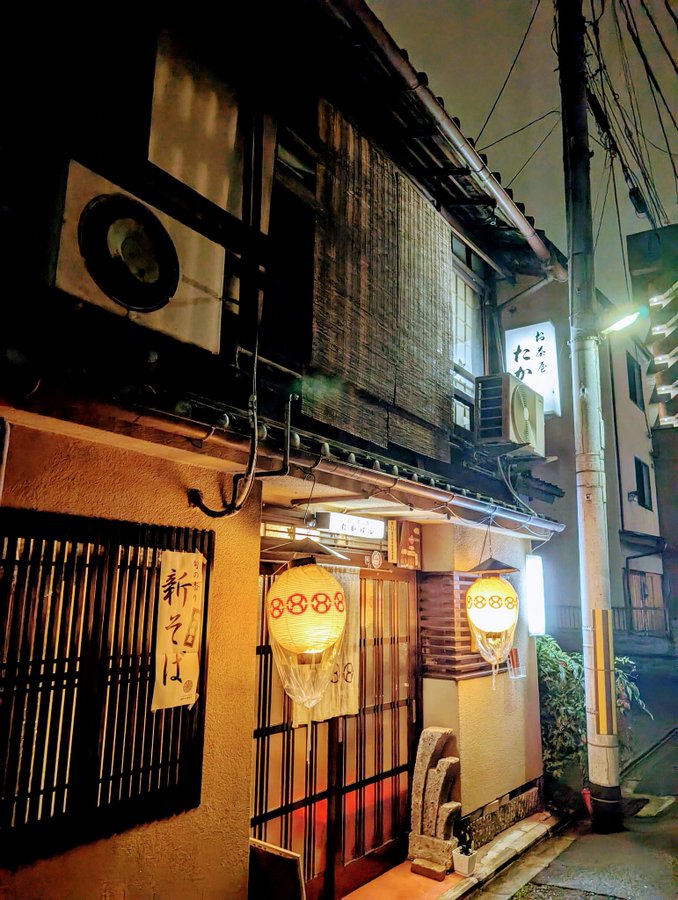
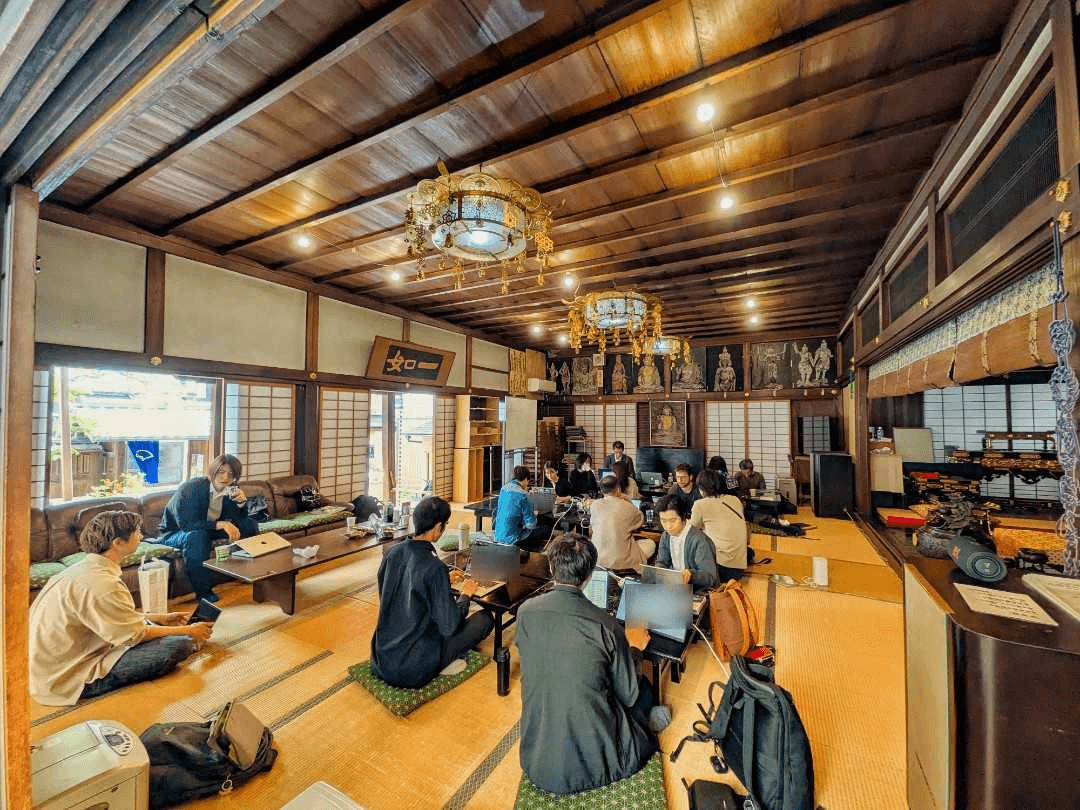
Miyako de IT also regularly uses unconventional spaces, including Butsugenji Temple, Kokando in a Kyoto machiya townhouse, Takahashi in a former ochaya teahouse, and Daikoji Temple in Fushimi Ward. See Work Spots for IT Engineers in Kyoto for details.
---
Where to live: the daily geography of an IT engineer in Kyoto
When working as an engineer in Kyoto, where you live also has direct practical consequences.
- Shijo-Karasuma to Karasuma-Oike: A dense concentration of Kyoto's IT hubs and coworking spaces, convenient for both commuting to offices and attending study groups
- South of Kyoto Station and Fushimi Ward: Relatively low rent and good Shinkansen access, suited to people who travel to Tokyo for work
- Kitashirakawa and Demachiyanagi: Near Kyoto University and close to academic communities
- Iwakura and northern Kyoto: Close to nature, suited to fully remote engineers seeking quiet concentration
- Uji and the Otsu area: Lower rent while remaining within commuting distance of Kyoto City
Kyoto has well-developed public transportation, so commuting and traveling to community events is relatively low-stress for engineers.
---
Benefits of working in Kyoto
- Lower living costs than Tokyo — Both rent and prices are lower, making it easier to increase disposable income
- Nature and culture are nearby — Mountains, rivers, and temples are all within 30 minutes
- Universities and research institutions are nearby — Easier access to academia–industry collaboration and information from research fields
- An appropriate population scale — Communities where people recognize one another can function
- Mobility as an international city — Digital nomads and overseas researchers continually come and go; see the Digital Nomad Kyoto co-hosted event report
---
Points to consider when working in Kyoto
- There are fewer companies than in Tokyo — The range of possible employers is relatively narrow
- Salary levels are often lower than in Tokyo — Living costs can offset the difference, but gross pay may decrease
- English-language working environments are limited — With some exceptions, Japanese is the main working language
- Isolation in remote work — If you work fully remotely, see Addressing Engineer Isolation in the Remote-Work Era
---
Frequently asked questions
Q. How much do IT engineers earn in Kyoto?
No range is stated here, because we have not been able to obtain published figures whose source and aggregation conditions we can verify. A comparison with Tokyo is only meaningful using the same survey, the same role classification, and the same year. Check the expected salary stated in each job description, together with the employer's explanation of grading and evaluation. How to read those figures is covered in the salary guide.Q. What kinds of IT companies are in Kyoto?
There are four categories: established technology companies such as Nintendo, Kyocera, SCREEN, OMRON, Murata Manufacturing, and Nidec; internet companies such as Hatena; contract developers and systems integrators; and startups in fintech, AI, Web3, tourism technology, and climate technology. See IT Companies in Kyoto for details.
Q. Which IT engineer communities can I join in Kyoto?
Miyako de IT is a Kyoto-based IT engineer community with more than 647 members and a record of more than 164 events. It holds monthly co-working study sessions, networking events, and hands-on workshops. See 15 IT Engineer Communities for a comparison.Q. Is it easy to work remotely in Kyoto?
Kyoto has many coworking options, including KOIN, UNKNOWN KYOTO, and .andwork kyoto. Work environments in temples and machiya townhouses are also available. See Work Spots for IT Engineers in Kyoto for details.
Q. What career paths are available to IT engineers in Kyoto?
Options include deepening as an individual contributor, locally rooted work such as digital-transformation support and academia–industry collaboration, multiple jobs or independence, and community operations or education. Kyoto makes it relatively easy to build a career that is not tied to a major metropolitan area.
Q. How do I get started as an IT engineer in Kyoto?
The shortest route is to visit a study group or community and understand the atmosphere. Miyako de IT's events welcome first-time participants. Also see For First-Time Participants.
---
Conclusion: choose Kyoto's IT engineering market for its quality
A career as an IT engineer in Kyoto does not compete on sheer quantity. For people who want to work by making use of distinctive companies, dense communities, characteristic work environments, and a unique culture, Kyoto is a city with options unavailable elsewhere.
If you are considering working in Kyoto, or already live here and want to meet more people, begin by attending a Miyako de IT event. It is an accessible way to understand the atmosphere of Kyoto's IT world. Representative Tomohiro Iida also participates on site.
---
Related links
- IT Companies in Kyoto: /en/blog/kyoto-it-companies
- Work Spots for IT Engineers in Kyoto: /en/blog/kyoto-work-spots
- 15 IT Engineer Communities: /en/blog/it-community-guide
- Survival Strategies for Regional IT Engineers: /en/blog/regional-engineer-career
- Why Kyoto Needs IT Engineer Communities for Academia–Industry Collaboration: /en/blog/academia-it-community
- Addressing Engineer Isolation in the Remote-Work Era: /en/blog/remote-engineer-loneliness
- Seven Ways IT Engineers Can Build Networks Through Communities: /en/blog/community-networking
- Comparing Communities Across Kansai: Kyoto, Osaka, and Kobe
- Finding a Technical Advisor, Fractional CTO, or Digital-Transformation Consultant in Kyoto
- Benefits of Working in Kyoto as a Freelance IT Engineer
- Official Miyako de IT website: /en / Events: /en/events / For First-Time Participants: /en/first-time / Event archive: /en/archive
Related articles
IT Engineer Salaries in Kyoto: Reading the Figures Through Their Sources and Compilation Conditions (2026 Edition)
An article for reading the salaries of IT engineers working in Kyoto without asserting a single average figure. It sets out the difference between public statistics and job-listing statistics, the nine items that must accompany any figure, and the procedure for checking figures against your own circumstances. The August 2026 update removed the salary ranges by years of experience and by role for which no source could be shown, along with the comparison table that stated a fixed figure for the gap with Tokyo. Compiled by the editorial team of the Kyoto IT engineer community Miyako de IT (7 years, 164 events).
15 Active IT Engineer Communities to Join in 2026
A catalog of 15 communities for IT engineers—nine nationwide and six regional. Compiled from 7 years and 164 events of community operations in Kyoto, it covers choosing by learning, networking, speaking, or region; four steps to a first visit; and common questions. This is not an exhaustive nationwide list. The order is not a ranking, and each community's activity was checked against primary sources such as official sites and connpass.
Changing Jobs as an Engineer in Kyoto (2026): Process, Major Agents, Application Routes, and U/I-Turn Support
How to go about changing engineering jobs in Kyoto, organized around the Kyoto coverage of the major recruitment services, five application routes, routes for people without experience, and U/I-turn support, using official information from public bodies and from each company. We do not rank the services; we state the intended users, the areas covered, the main roles, the verification date, the cost, and the official URL. Salaries by role have been moved to a separate salary guide. Written from the perspective of the Kyoto IT engineer community Miyako de IT (7 years, 164 events, 647 members).
Source data
The figures cited in this article are based on primary data in the Miyako de IT annual statistics report. It publishes yearly event counts, venue distribution, and event-format data.
Written by
Miyako de IT
Open event related to this article
 Waitlist
Oct 31 (Sat)
Original event title