
20 IT Companies in Kyoto [2026]: Headquarters, Development Bases, and Official URLs
![20 IT Companies in Kyoto [2026]: Headquarters, Development Bases, and Official URLs](/blog/kyoto-it-companies.jpg)
Updated: October 18, 2026. KYOSO, System D and GENECH COMMUNICATIONS were checked against their official company profiles on this date; figures for other entries may still reflect earlier reporting periods.
This article is based on published primary sources such as each company's official website, securities reports, and public statistics. Locations, business activities, employee numbers, and hiring status may change. Please check each company's official page for the latest information before applying.
The listing order does not indicate ranking. We do not publish information we cannot verify.
Key points from this article (30-second read)
- It lists 20 major IT and web-related companies in Kyoto Prefecture by industry category, with location, employee numbers, business field, and official URL.
- It uses six categories: major electronics and components; games and entertainment; apparel; web and internet; SaaS and AI startups; and software development and systems integration.
- Companies include Nintendo, Kyocera, Murata Manufacturing, Nidec, OMRON, ROHM, Shimadzu, SCREEN Holdings, Hatena, GENECH COMMUNICATIONS, Money Forward, HACARUS, Baseconnect, and others.
- It also sets out four criteria for choosing an employer when changing jobs or starting a career—business field, working style, salary range, and growth stage—alongside salary levels in Kyoto.
- Written from the on-the-ground perspective of the Kyoto IT engineer community Miyako de IT (7 years, 164 events, 647 members).
The phrase “IT companies in Kyoto” mixes together headquarters in Kyoto, branch offices, research bases, factories, and recruitment locations. This article treats those types of office separately.
How we classify types of offices
- Headquarters: the registered head office, which also holds the main decision-making functions
- Major office: a location other than the headquarters that carries a core business function
- Research and development base: a location whose main function is research and development
- Factory: a location whose main function is manufacturing
- Sales office: a location whose main function is sales
- Registration confirmed only: a location whose operation cannot be confirmed beyond its registration record
- Confirmed from recruitment information: a location confirmed only from the work locations stated on a recruitment page
We do not include companies with only a registered address, or former offices, in order to make the count look larger. The list in this article is limited to companies with a headquarters or a major development base in Kyoto Prefecture.
The items we state for each company
- Company name
- Type of Kyoto office
- Location
- Main business
- Recruitment page
- Official URL
- Date last verified
The table lists the company name, location, main business, approximate scale, and official URL. The type of office appears in each company's entry and in the surrounding text, and recruitment-page URLs are collected in The Kyoto Engineer Career-Change Guide.
Listing criteria
- An official site or an official company-information page exists
- An update date or the company's recent business status can be confirmed
- The location, business activities, and scale can be confirmed from primary sources
- We do not rely on reposts from other sites alone
- We check for closure, relocation, and consolidation
- We state whether listings can be paid for; this article has no paid listing slots
- When we list ourselves or a related organization, we state the role and the relationship
*The companies and offices listed here are reviewed periodically. Employee figures mix consolidated and parent-company measures, are approximate, and do not indicate a ranking.*
Introduction: an overview of Kyoto's IT and web companies
The best-known large companies headquartered in Kyoto are global manufacturers whose products and businesses hold high global market share: Nintendo, Kyocera, Murata Manufacturing, Nidec, OMRON, ROHM, Shimadzu, and SCREEN Holdings. Among web businesses, Hatena and Money Forward's Kansai development base operate in Kyoto; GENECH COMMUNICATIONS is a Kyoto-headquartered cloud and systems provider. Among AI and SaaS startups, HACARUS and Baseconnect are known as Kyoto-founded companies. Kyoto's IT and technology companies are easier to grasp through six categories: major electronics and components; games and entertainment; apparel; web and internet; SaaS and AI startups; and software development and systems integration. This article introduces 20 companies with a headquarters or a major development base in Kyoto Prefecture, with a list by industry category and an explanation of each sector. For the wider picture of IT engineering in Kyoto—salaries, career changes, communities, and working styles as well as companies—see The Complete Guide to IT Engineers in Kyoto.The Kyoto IT engineer community Miyako de IT has held 164 events over 7 years. It has 647 registered connpass members, which is a registration count and not a count of actual attendees or of people connected with companies. Drawing on what we have seen while running those events, this article organizes the criteria for choosing an employer on a factual basis.
---
Chapter 1: characteristics of Kyoto's IT and web companies
In short: Kyoto's IT sector is characterized by a cluster of niche-leading companies with top global market share, coexisting with web, SaaS, and AI startups. Kyoto Prefecture has far fewer technology companies per resident than Tokyo, but Kyoto-founded global companies such as Nintendo, Kyocera, Murata Manufacturing, Nidec, and ROHM each lead a global market in a particular field, which gives people who want a research-and-development or global product career based in Kyoto a substantial range of options.A cluster of games and entertainment
Kyoto is one of the birthplaces of the game industry. Nintendo has maintained its headquarters in Minami Ward, Kyoto City, since its founding in 1889, and the contract game developer TOSE is headquartered in Oyamazaki, Kyoto Prefecture. For IT engineers aiming at the game industry, Kyoto is one of the main bases alongside Tokyo and Osaka.
A cluster of AI and Web3 startups
In recent years, AI, SaaS, and Web3 startups have gathered around innovation hubs including Kyoto Research Park (KRP), operated by Kyoto Research Park Corp., along with KOIN and QUESTION. HACARUS (sparse-modeling AI) and Baseconnect (company-data SaaS) are examples. Kyoto Prefecture also runs communities for the metaverse and Web3, so investment in new fields is proceeding at the local-government level as well.
How to read working conditions and wage levels
When you compare wage levels with another region, you have to compare data from the same survey, the same occupational classification, and the same year. Because the definition and scope of an occupation differ by survey, this article does not state a fixed figure for the gap with Tokyo. For levels in Kyoto Prefecture, see the public and job-listing statistics in the next section and The Guide to IT Engineer Salaries in Kyoto.
On the living side, Kyoto University, Kyoto Institute of Technology, Doshisha University, and other universities are concentrated in and around the city, making it easy to find points of contact for academia–industry collaboration and graduate recruitment.
Salary levels in public statistics and job-listing statistics
When you look at salaries, separating “public statistics” from “job-listing statistics,” which survey different populations, brings you closer to reality. Because the two differ in occupational definition and method of calculation, the figures below are offered as reference points rather than assertions.
In public statistics, the “software creators” category for Kyoto Prefecture—roughly systems engineers and programmers—in Japan's Ministry of Health, Labour and Welfare 2024 Basic Survey on Wage Structure (by prefecture) shows monthly cash earnings of ¥418,500 and annual bonuses of ¥1,120,800, implying approximately ¥6.14 million a year (sample of 5,470 people, average age 38.8). The “systems consultants and designers” category, covering upstream work, implies approximately ¥7.53 million. Note that “software creators” is an occupational classification and does not map exactly onto the term “IT engineer” used in this article.
In job-listing statistics, Kyujin Box's salary guide, calculated from advertised jobs as of June 2026, places the average for systems engineers in Kyoto Prefecture at ¥5.23 million, which it calculates as the highest level in Kansai. For reference, its nationwide averages are ¥4.46 million for IT engineers and ¥5.23 million for game programmers. Because job-listing statistics are based on amounts advertised when recruiting, they can differ from what is actually paid.
A fuller explanation of salary levels, and the nine items you need in order to read the figures, are collected in The Guide to IT Engineer Salaries in Kyoto. Because figures from the same source have to be updated in both articles, treat the salary guide as the source of record when updating.
Sources: Japan's Ministry of Health, Labour and Welfare, 2024 Basic Survey on Wage Structure by prefecture (e-Stat); Kyujin Box salary-guide pages by occupation (Kyujin Box, as of June 2026). The figures are those at the time of the survey and are re-verified periodically.
Career paths
IT companies in Kyoto have a craft culture of refining a technology over decades. Large companies premised on long-term employment, such as Nintendo, Kyocera, and Murata Manufacturing, coexist with the career mobility of web companies such as Hatena and Money Forward, and that range—being able to choose a company that matches your own inclination—is characteristic of Kyoto. The formal corporate names are as given in the table above.
---
Chapter 2: 20 major IT and web companies in Kyoto, listed by industry category
The following is a list of 20 IT and web companies with a headquarters or a major development base in Kyoto Prefecture. The numbers are not a ranking; they are an index applied after grouping companies by industry category. Within each category, companies are ordered by year of establishment or by name. Locations, business fields, employee scale, and official URLs are based on company profiles and securities reporting from different periods; KYOSO and System D were rechecked October 18, 2026. The remaining rows require periodic revalidation. Employee figures mix consolidated and parent-company measures, so treat them as approximate.
| # | Company | Category | Kyoto location | Business field | Approximate scale | Official site (some pages are in Japanese) |
|---|---|---|---|---|---|---|
| 1 | Shimadzu Corporation | Major electronics and components | Nakagyo Ward, Kyoto | Precision, analytical, and medical instruments | Parent company: about 3,200 | https://www.shimadzu.co.jp/ |
| 2 | Wacoal Corp., part of Wacoal Holdings | Apparel | Minami Ward, Kyoto | Apparel, internal IT, and DX | Consolidated: about 20,000 | https://www.wacoalholdings.jp/ |
| 3 | SCREEN Holdings Co., Ltd. | Major electronics and components | Kamigyo Ward, Kyoto | Semiconductor and display manufacturing equipment | Consolidated: about 6,200 | https://www.screen.co.jp/ |
| 4 | Nissha Co., Ltd. | Major electronics and components | Nakagyo Ward, Kyoto | Printing, decorative films, and touch sensors | Consolidated: about 4,500 | https://www.nissha.com/ |
| 5 | OMRON Corporation | Major electronics and components | Shimogyo Ward, Kyoto | Sensing, factory automation, and healthcare | Parent company: about 5,400 | https://www.omron.com/jp/ja/ |
| 6 | Nichicon Corporation | Major electronics and components | Nakagyo Ward, Kyoto | Capacitors and power products | Parent company: about 1,200 | https://www.nichicon.co.jp/ |
| 7 | Nintendo Co., Ltd. | Games and entertainment | Minami Ward, Kyoto | Game hardware, software, and intellectual property | Consolidated: about 8,600 | https://www.nintendo.co.jp/ |
| 8 | ROHM Co., Ltd. | Major electronics and components | Ukyo Ward, Kyoto | Semiconductors and electronic components | Parent company: about 4,400 | https://www.rohm.co.jp/ |
| 9 | Murata Manufacturing Co., Ltd. | Major electronics and components | Nagaokakyo, Kyoto Prefecture | Electronic components, capacitors, and sensors | Consolidated: about 78,000 | https://corporate.murata.com/ja-jp |
| 10 | Kyocera Corporation | Major electronics and components | Fushimi Ward, Kyoto | Electronic components, communications equipment, and solar cells | Consolidated: about 79,000 | https://www.kyocera.co.jp/ |
| 11 | Nidec Corporation | Major electronics and components | Minami Ward, Kyoto | Precision motors, automotive, and industrial equipment | Consolidated: about 104,000 | https://www.nidec.com/jp/ |
| 12 | TOSE Co., Ltd. | Games and entertainment | Oyamazaki, Kyoto Prefecture | Contract game development | Consolidated: about 700 | https://www.tose.co.jp/ |
| 13 | KYOSO Co., Ltd. | Software development and systems integration | Nakagyo Ward, Kyoto | Applications, IT infrastructure and operations | 513 (official recruitment profile, November 2025) | https://www.kyoso.co.jp/company/ |
| 14 | System D Inc. | Software development and systems integration | Nakagyo Ward, Kyoto | Software for education, public administration and membership management | 325 (including subsidiaries, official company profile) | https://www.systemd.co.jp/company |
| 15 | Hatena Co., Ltd. | Web and internet | Nakagyo Ward, Kyoto | Web services including blogs and bookmarking | Parent company: about 200 | https://hatena.co.jp/ |
| 16 | HACARUS Inc. | SaaS and AI startup | Nakagyo Ward, Kyoto | Sparse-modeling AI SaaS | About 50 | https://hacarus.com/ |
| 17 | Baseconnect Inc. | SaaS and AI startup | Nakagyo Ward, Kyoto | Musubu company-information database SaaS | About 30 | https://baseconnect.in/ |
| 18 | GENECH COMMUNICATIONS Co., Ltd. | Software development and systems integration | Nakagyo Ward, Kyoto | AWS cloud, IoT, applications and systems development | Check current headcount on official site | https://www.genech.co.jp/about-us/profile |
| 19 | Money Forward, Inc., Kansai development office | Web and internet | Nakagyo Ward, Kyoto | Cloud accounting and back-office SaaS | Kyoto office: about 100 | https://kyoto.moneyforward.com/ |
| 20 | Netsujo Inc. | SaaS and AI startup | Shimogyo Ward, Kyoto | Web3 and AI contract development and community operations | Startup | https://netsujo.jp/ |
Verify the employer and the actual Kyoto job before applying (October 18, 2026)
A corporate headquarters in Kyoto does not establish that a role is currently advertised there. First check each company's official corporate profile for its office location. Then open its own recruitment page and confirm the job title, work location, remote/on-site requirements, employment type and application deadline. A job in Tokyo or Osaka must not be described as Kyoto recruitment merely because the company has a Kyoto headquarters.
We replaced two research or incubation operators and one unverified former development office with three documented Kyoto-headquartered software employers: KYOSO (see also its official recruitment profile), System D and GENECH COMMUNICATIONS. Their listed employee counts come from the sources cited in the table. These are corporate headcounts, not counts of open positions.
An earlier row for LY Corporation's former Kyoto office was dropped because current Kyoto staffing and hiring could not be established from a current primary source. GENECH COMMUNICATIONS' official company profile verifies its Kyoto headquarters, and its official recruitment portal lists technical roles. Each job's current location and application terms still require verification.
#### Recruitment versus corporate partnership
Candidates should apply through the companies' own recruitment channels. Companies, universities and community organizations interested in meeting Kyoto technical talent through events can consult Miyako de IT's sponsorship information or its contact page. Sponsorship does not confer preferential inclusion or ranking in this editorial list.
---
Kyoto's major companies by scale: an approximate guide to employee numbers
For the questions “which are Kyoto's large and well-known companies?” and “which are the largest by size?”, employee numbers are a useful guide to the overall picture. The list below takes the companies above whose consolidated employee numbers are particularly large—major electronics and components manufacturers—and arranges them by approximate scale (this is not a formal ranking, and it mixes consolidated and parent-company measures; check each company's current securities report).
- Nidec Corporation, formerly Nihon Densan — consolidated: about 104,000 (precision motors and automotive)
- Kyocera Corporation — consolidated: about 79,000 (electronic components and communications equipment)
- Murata Manufacturing Co., Ltd. — consolidated: about 78,000 (electronic components)
- Nintendo Co., Ltd. — consolidated: about 8,600 (games)
- SCREEN Holdings Co., Ltd. — consolidated: about 6,200 (semiconductor manufacturing equipment)
- OMRON Corporation — parent company: about 5,400 (sensing and factory automation)
- Nissha Co., Ltd. — consolidated: about 4,500 (decorative films and touch sensors)
- ROHM Co., Ltd. — parent company: about 4,400 (semiconductors and electronic components)
That global electronics and components manufacturers such as Nintendo, Kyocera, Murata Manufacturing, Nidec, OMRON, and ROHM are headquartered in Kyoto is a defining feature of the city's IT and technology sector. At the same time, smaller but technically strong web, SaaS, and AI companies—Hatena, HACARUS, and Baseconnect among them—are also clustered here, so the choice divides between the stability of a large company and the autonomy of a startup. Each company's business field is as given in the table above.
How major manufacturers and web companies differ in Kyoto, in work and career terms
For people who want to work at a large Kyoto company or manufacturer, or who want to know how that differs from a web company, here is a factual comparison of the two cultures.
Major electronics and electronic components manufacturers—Kyocera, Murata Manufacturing, Nidec, OMRON, ROHM, Shimadzu, and SCREEN Holdings among them—are largely niche-leading companies that lead a global market in their own field. A culture of accumulating technology over decades on the premise of long-term employment is well established, and their recruitment pages at times list roles for IT people in research, embedded engineering, firmware, and internal DX and IT departments. In research, development, and manufacturing roles, the proportion of time spent on site tends to be higher because of equipment and prototyping. Web, SaaS and AI product companies—Hatena, Money Forward's Kansai development base and Baseconnect among them—work in different engineering environments. Software development and systems integration firms such as KYOSO, System D and GENECH COMMUNICATIONS cover applications, infrastructure, public-sector systems, cloud and IoT. Confirm work location, team and actual technical stack in the job listing rather than inferring terms from a whole-company category.Neither is better than the other. The axis for choosing a company in Kyoto is whether you want to settle in and go deep technically, or to prioritize autonomy and speed. If you are starting your studies and aiming at a Kyoto company, see also How to Learn Programming in Kyoto, which sets out how to choose among self-study, schools, and study groups.
---
Chapter 3: characteristics by sector, and options by professional interest
In short: Kyoto offers concrete company options for each of six interests—games, web, research and development, startups, major electronics, and apparel combined with IT. This chapter organizes, on a factual basis, which companies correspond to which role or interest. It is not an evaluation of which company is better; use it as a map for finding the companies that match your own inclination.If you want to work in games
The main companies where you can gain game-development experience in Kyoto are Nintendo (Minami Ward, Kyoto; consolidated about 8,600) and TOSE (Oyamazaki; consolidated about 700). Nintendo develops hardware and software end to end around its own intellectual property, while TOSE specializes in contract game development and reports experience across more than 2,300 titles for major domestic publishers. The choice reflects whether you want to take your own IP to a global market or gain cross-genre experience through contract work.
If you want to work in web and internet services
For web products, Hatena (Nakagyo Ward, Kyoto) runs its own web services and Money Forward's Kansai development base works on business SaaS. Verify the current engineering roles and work locations with their recruitment sites.
If you want to build business software or IT infrastructure
KYOSO develops applications and IT infrastructure, System D develops business software for education and public-sector organizations, and GENECH COMMUNICATIONS provides AWS/cloud, IoT and application development. The three companies have officially listed headquarters in Nakagyo Ward, Kyoto. GENECH's recruitment portal advertises engineering job families, but individual job availability and work location change; the official listing is authoritative.If you want to work in research and development
Companies that recruit continuously for research and development include OMRON (sensing, AI, and robotics), Murata Manufacturing (basic research and materials development for electronic components), Shimadzu (analytical and medical instruments, and the employer of a Nobel laureate in chemistry), Advanced Telecommunications Research Institute International (ATR) (a telecommunications research institute working on neuroscience, brain–machine interfaces, and natural-language processing), and SCREEN Holdings (semiconductor manufacturing equipment). Master's and doctoral recruitment and career paths through academia–industry projects are common in these fields.
If you want a startup or small, focused team
Representative Kyoto-founded startups include HACARUS (sparse-modeling AI; Nakagyo Ward, Kyoto; about 50), Baseconnect (the Musubu company-information database SaaS; Nakagyo Ward, Kyoto; about 30), and Netsujo (Web3 and AI contract development; Shimogyo Ward, Kyoto). Kyoto Research Park (KRP), operated by Kyoto Research Park Corp., houses roughly 500 organizations and 6,400 people and is a place where startups in AI, biotechnology, healthcare, mobility, and other fields are clustered.
If you want major electronics and electronic components
Kyocera, Murata Manufacturing, Nidec, OMRON, ROHM, Shimadzu, SCREEN Holdings, Nissha, and Nichicon are all global companies headquartered in Kyoto. These companies may recruit for engineering and internal IT roles, but vacancies, job requirements and locations change. Check official recruitment listings.If you want apparel combined with IT
Wacoal (Minami Ward, Kyoto; consolidated about 20,000, with Wacoal Holdings as the holding company) is an apparel company that nonetheless recruits internal IT and DX talent on a continuing basis for work such as using 3D measurement data, running its e-commerce site, and digitalizing stores. It is an option for people interested in apparel combined with technology.---
Chapter 4: what to consider when choosing an IT or web company in Kyoto
In short: choosing a company in Kyoto becomes easier when you compare on four axes—business field, working style, salary range, and growth stage. The table sets out what to check on each axis, and the sections that follow cover considerations particular to Kyoto: location, culture, academia–industry collaboration, and communities.Four criteria for choosing an employer: a comparison table
| Criterion | What to check | Where to check, and related reading |
|---|---|---|
| Business field | Which area you want to work in: major electronics and components, games, web, SaaS and AI, or research institutions | The table in Chapter 2 and the sector notes in Chapter 3 |
| Working style | Whether remote work is allowed, how often you go into an office, and the work location: Kyoto headquarters or a Tokyo base | The job description on each company's recruitment page |
| Salary range | The market level by role and experience, and how it differs from the amount advertised | The Complete Guide to IT Engineer Salaries in Kyoto |
| Growth stage | Large-company stability and technical depth, or startup autonomy and speed | Employee scale in Chapter 2 and The Kyoto IT Engineer Career-Change Guide |
Of the four, business field and growth stage can be narrowed down using the table and the sector notes in this article. Working style and salary range vary considerably by opening, so always check the current job description on each company's recruitment page before applying.
Working style: remote and hybrid arrangements
Working styles at Kyoto IT companies vary by sector. Remote and hybrid arrangements are increasingly common at web, SaaS, and startup companies, and some development bases hire nationwide on a fully remote basis. In research and development, electronic components, and manufacturing, on the other hand, the proportion of time spent on site is higher because of equipment and prototyping. Conditions differ by opening, so we recommend checking the remote policy, office frequency, and work location on each company's recruitment page before applying.
Kyoto is a compact city, so commuting is light and it is easier to keep some room in your life even in a role that assumes office attendance. If you work mainly remotely, co-working sessions and networking events can supply in-person contact and make isolation less likely; if this is new to you, For First-Time Participants describes the atmosphere.
Office locations and commuting
IT companies within Kyoto City are concentrated around Shijo-Karasuma, Kawaramachi, Kyoto Station, Kyoto Research Park in Shimogyo Ward, Fushimi Ward, and Minami Ward. Within the city, a bicycle commute is often possible, and the long commutes common in Tokyo rarely occur. For Murata Manufacturing in Nagaokakyo or TOSE in Oyamazaki, the JR Kyoto Line and the Hankyu Kyoto Line are the main routes.
Culture particular to Kyoto
Kyoto corporate culture is often characterized by pursuing authenticity, preferring long-term value to short-term profit, and keeping information confidential. Nintendo, Kyocera, and Murata Manufacturing are typical of this culture, with personnel systems premised on long tenure by new graduates and early-career hires. Hatena, Money Forward, and Baseconnect, by contrast, have a more fluid web-company culture, and the coexistence of both is characteristic of Kyoto.
Active academia–industry collaboration
The concentration of technical universities—Kyoto University, Kyoto Institute of Technology, Doshisha University, and Ritsumeikan University, whose College of Information Science and Engineering moved to the Osaka Ibaraki campus in April 2024—is high even by international standards. Opportunities for academia–industry projects, joint research, and internships are plentiful, making it easier for early-career researchers to plan a career. Miyako de IT also puts this into practice as collaboration with universities and educational institutions.
The presence of communities
Kyoto has regular co-working sessions, study groups, and technical conferences run by communities including Miyako de IT. Miyako de IT was founded in 2019 and has held 164 events over 7 years, gathering more than 647 members. Being able to meet IT engineers at other companies through a community—people you would rarely encounter through your employer alone—is another advantage of Kyoto.
Options besides permanent employment: freelancing
In Kyoto you are not limited to permanent employment; working as a freelance IT engineer is also an option. Kyoto City has coworking spaces and IT engineer communities, and Miyako de IT events are attended by a mix of employees, freelancers, and students. The Advantages of Working as a Freelance IT Engineer in Kyoto covers the city from a freelancer's point of view.
---
Frequently asked questions about well-known companies headquartered in Kyoto
Q. Which well-known large companies are headquartered in Kyoto?
The best-known large companies headquartered in Kyoto are global manufacturers such as Nintendo (games), Kyocera, Murata Manufacturing, Nidec, OMRON, ROHM, Shimadzu, and SCREEN Holdings. By employee scale, Nidec (consolidated about 104,000), Kyocera (consolidated about 79,000), and Murata Manufacturing (consolidated about 78,000) are particularly large, and each leads a global market in its own field. Employee figures mix consolidated and parent-company measures, are approximate, and are not a formal ranking; check each company's current securities report.
Q. Which IT and web companies have a headquarters or development base in Kyoto?
In web services, Hatena (Nakagyo Ward, Kyoto) and Money Forward's Kansai development base (Nakagyo Ward, Kyoto) are examples. In software and systems integration, KYOSO, System D and GENECH COMMUNICATIONS have headquarters in Nakagyo Ward. Among AI and SaaS startups, HACARUS (sparse-modeling AI; Nakagyo Ward, Kyoto), Baseconnect (the Musubu company-information database SaaS; Nakagyo Ward, Kyoto), and Netsujo (Web3 and AI contract development; Shimogyo Ward, Kyoto) are known as Kyoto-founded companies. Each company's location, business field, employee scale, and official URL are collected in the table of 20 major IT and web companies above.
Q. Which game companies and manufacturers are in Kyoto?
In games and entertainment, Nintendo (Minami Ward, Kyoto) and the contract game developer TOSE (Oyamazaki, Kyoto Prefecture) are headquartered in Kyoto. Among major electronics and components manufacturers, in addition to Kyocera, Murata Manufacturing, Nidec, OMRON, ROHM, Shimadzu, and SCREEN Holdings mentioned above, Nissha and Nichicon are headquartered within Kyoto City.
Q. What do IT engineers at these companies earn?
There is no single figure. As shown in “Salary levels in public statistics and job-listing statistics” above, public statistics (wages actually paid) and job-listing statistics (amounts advertised when recruiting) measure different things. How to check figures by role, and the nine items you need in order to read them, are collected in The Guide to IT Engineer Salaries in Kyoto. For a specific employer, check the expected salary range stated in its job description.
---
Chapter 5: conclusion—working at an IT or web company in Kyoto
Kyoto has fewer options in total than Tokyo, but it has a distinctive ecosystem in which niche-leading companies with global market leadership—Nintendo, Kyocera, Murata Manufacturing, Nidec, and ROHM among them—coexist with fast-growing AI, SaaS, and Web3 startups such as HACARUS, Baseconnect, and Netsujo. Taking living costs and rent, the concentration of universities, and the density of communities together, Kyoto is a credible option for an IT engineer. Use the list by industry category and the notes by professional interest in this article as a map for finding the company that suits you. For salary levels in detail, see The Complete Guide to IT Engineer Salaries in Kyoto; for how to go about a career change, The Kyoto IT Engineer Career-Change Guide; and for the overall picture of IT engineering in Kyoto, The Complete Guide to IT Engineers in Kyoto.
About the Miyako de IT community
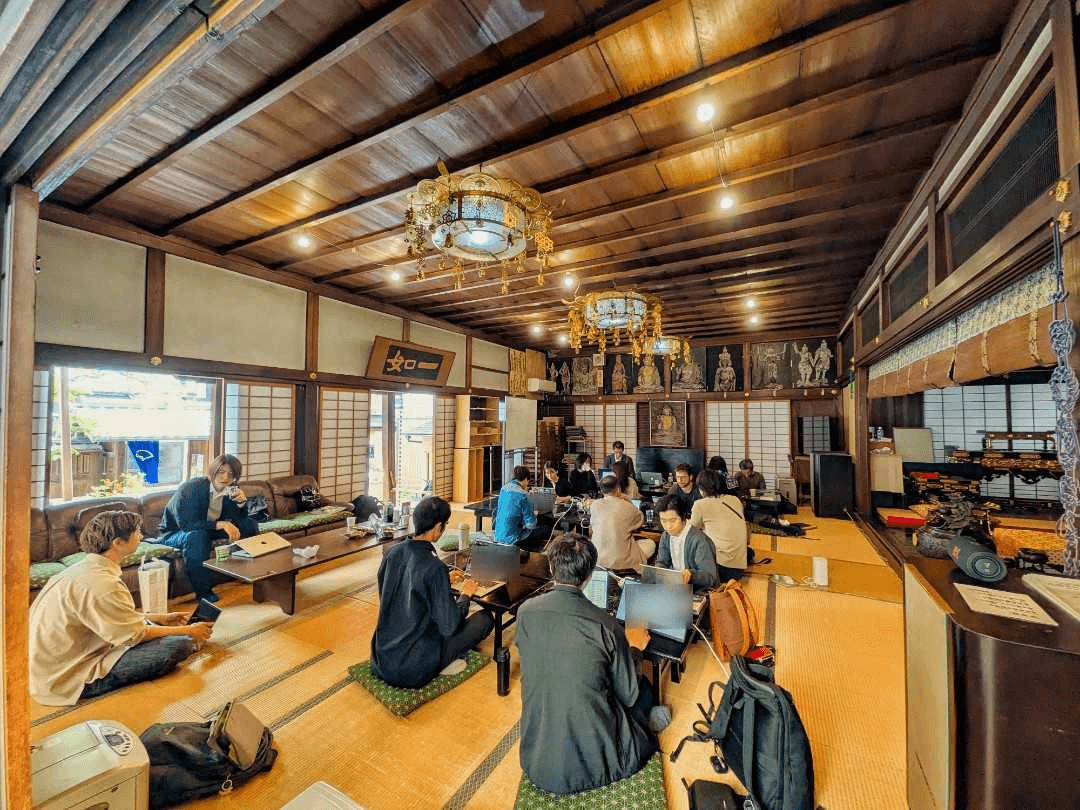
As a place for people who work, or want to work, at a Kyoto IT company, we run the Kyoto IT engineer community Miyako de IT. It regularly holds co-working sessions, lightning talks, and career conversations at temples and machiya townhouses. To get a feel for how working IT engineers in Kyoto talk and think, join through the event calendar.
What is actually happening inside Kyoto's IT sector—study groups, academia–industry work, and collaboration with public bodies—is covered by The Kyoto IT Scene. This article handles the company list and how to choose among them; that one handles the activity taking place in the region. To read the Kyoto IT-engineer articles together, start from the article index.
Sponsorship for companies
To support the growth of Kyoto's IT industry and the development of its people, Miyako de IT is looking for corporate sponsors. We have a record of working with local government (Kyoto City and Kyoto Prefecture), universities, and communities, and sponsorship can be used for technical branding and recruitment communication from a Kyoto base. See the sponsorship information for details.
Update history
- August 5, 2026: added the listing criteria; added the date of the last check against official primary sources; stated how types of office are classified and which items are listed; removed the statement giving a fixed figure for the wage gap with Tokyo; stated the relationship with the operating company, Netsujo Inc.; fixed the broken destination of the sponsorship link (/sponsor-guide to /sponsor)
Related articles
In Kyoto, Making Something Together: The Connections We Hope to Nurture at Miyako de IT
What makes an IT community worth returning to? Miyako de IT founder Tomohiro Iida reflects on meeting people in Kyoto, following curiosity, and supporting small personal challenges.
A Four-Line Help Note Inspired by a Kyoto Mokumoku Session
Using Miyako de IT's Daikoji session as context, a practical four-line help note for discussing blockers with someone new—without claiming unmeasured outcomes.
How to Make an AI-Agent Lightning Talk Verifiable: A Public PASS–FAIL–PASS Demo on One Slide
A reproducible AI lightning-talk demo example with public Agent Role Contracts inputs, an intended failure, historical CI, and explicit limits.
Source data
The figures cited in this article are based on primary data in the Miyako de IT annual statistics report. It publishes yearly event counts, venue distribution, and event-format data.
Written by
Tomohiro Iida
Open event related to this article
 Waitlist
Oct 31 (Sat)
Original event title