
15 Active IT Engineer Communities to Join in 2026
This 2026 catalog explains how to find and choose communities nationwide and by region.
Last verified: August 5, 2026
This article is based on published primary sources such as each group's official website, official event pages, and announcements from public bodies. Activity status, location, fees, recruitment, and services offered may change. Please check each group's official page for the latest information before taking part.
The listing order does not indicate ranking. We do not publish information we cannot verify.
Key points (30 seconds)
- Choose an IT engineer community by one of four purposes: learning, networking, speaking, or region
- This article introduces nine nationwide and six regional communities, including Kyoto's Miyako de IT
- Activity at all 15 was verified through primary sources such as official websites and connpass for 2025–2026 (detailed check on July 10, 2026; major official pages rechecked July 11)
- The order is not a ranking; it is organized as guidance by purpose and region
- Begin by creating a connpass account. Events marked “listening only is welcome” and co-working study sessions are accessible entrances
When you look for a community for IT engineers, what matters is less the number of names than whether a group is still active and whether its purpose and format match yours.
This article lists groups whose activity since 2025 could be confirmed on an official website or an official event page, organized by purpose: learning, networking, speaking, region, and specific technologies. It was compiled from 7 years and 164 sessions of operating the Kyoto IT engineer community Miyako de IT.
This is not an article that covers every community in Japan. A group that meets often is not necessarily suited to beginners. Check its recent events, code of conduct, fees, and the region where it meets before choosing.
For the underlying questions—what an IT community is and what participation provides—read The Complete Guide to IT Communities first. This catalog focuses on specific organizations.
Choosing an IT engineer community—four purpose axes
The first thing to decide is your purpose for taking part. Once that is settled, the candidates narrow naturally.
1. Learning—deepen a specific technologyFor AWS, Azure, Python, PHP, Vue.js, Kubernetes, or another technology, its user group is the first candidate. Practitioners using the same technology can understand precise questions and share field knowledge.
2. Networking—find peers who can talk about technologyGeneral communities and those centered on co-working or networking suit this purpose. For remote IT engineers with fewer contacts outside work, recurring face-to-face meetings provide value beyond learning. Remote IT Engineer Loneliness and Five Responses discusses this further.
3. Speaking—build a record of outputChoose a community with recurring lightning talks. You can progress from a five-minute talk to a regular meeting and then an annual conference. Candidates include the lightning-talk-centered IoTLT and communities with conferences such as Vue Fes Japan and JAWS DAYS.
4. Region—participate continuously near homeIf continuity matters most, a community within traveling distance is practical. Kyoto, Kanazawa, Hiroshima, Fukuoka, Sapporo, and cities nationwide have continuing groups. Online participation provides additional choices outside major cities.
Listing criteria—verifiability, not a recommendation ranking
The criteria for listing are not name recognition or member counts. We selected groups meeting the following conditions, while avoiding an excessive skew in technical area, purpose, or region.
- An official site or an official event page exists
- An update date or recent activity can be confirmed—in this article, activity during 2025 or 2026
- The intended participants, event format, and how to take part can be confirmed from primary sources
- We do not rely on reposts from other sites alone
- We check for closure, suspension, and relocation
- We state whether listings can be paid for; this article has no paid listing slots
- When we list ourselves or a related group, we state the role and the relationship
- The listing order is not treated as a ranking
“15 with confirmed activity” better preserves accuracy and updateability than a stronger heading such as “the 15 best.” Numbers are not used as evidence of scale or superiority.
The items we check for each group
For each group, we check the following items.
- Name
- Main themes
- Intended participants
- Event format
- Main region
- The most recent activity we could confirm
- Official URL
- Date last verified
- Points to note on a first visit
In the body, the main themes, intended participants, event format, main region, most recent confirmed activity, and official URL appear in each group's entry. The date last verified is given in “Update policy” at the end, and the points to note on a first visit are collected in the “accessible entrance” column of the quick reference and in “Getting started.”
About listing our own community
Miyako de IT, which edits this article, is also one of the groups listed. It is an IT engineer community in Kyoto, run since 2025 as an official business of Netsujo Inc. (Shimogyo Ward, Kyoto). We do not rank it against other groups and describe it under the same items as everyone else.
Quick reference: 15 communities
| Community | Main theme | Base | Accessible entrance |
|---|---|---|---|
| JAWS-UG | AWS | Nationwide chapters | A local-chapter study group |
| JAZUG | Microsoft Azure | Nationwide, centered on Tokyo | Tokyo Jazug Night |
| GDG Tokyo | Google technologies | Tokyo | A hands-on event |
| Vue.js Japan User Group | Vue.js | Nationwide | v-tokyo Meetup or translation |
| Kubernetes Meetup Tokyo | Kubernetes | Tokyo and online | A KubeCon recap |
| PHP Study Group Tokyo | PHP | Tokyo | Monthly study group |
| PyLadies Tokyo | Python | Tokyo | Monthly meetup |
| IoTLT | IoT | Nationwide and online | Monthly lightning-talk event; listening welcome |
| Code for Japan | Civic tech | Nationwide | Regional brigades or Summit |
| Miyako de IT | General technology | Kyoto | Co-working or networking event |
| Kyoto.js | JavaScript | Kyoto | Annual study group |
| Kanazawa.rb | Ruby | Kanazawa | Monthly meetup |
| Sugoi Hiroshima | General technology | Hiroshima | Wednesday co-working session |
| Engineer Cafe | General technology | Fukuoka | Facility use or study groups |
| Sapporo Engineer Base | General technology | Sapporo | Co-working sessions and meetups |
Nine nationwide IT engineer communities
These technology-focused communities are generally accessible regardless of residence through online events or regional chapters.
1. JAWS-UG (AWS Users Group – Japan)
An AWS user community launched in February 2010 and described by its official site as nonprofit and volunteer-operated. Local chapters hold study and networking events nationwide. Large 2026 events include JAWS SONIC in September and JAWS FESTA in November.
- Best for: People who use or want to learn AWS and want recurring participation in a local chapter
- Official information: Official site (Chapter list)
2. JAZUG (Japan Azure User Group)
Japan's Microsoft Azure user community, founded in August 2010. Its recurring Tokyo Jazug Night reached event 61 in July 2026. JAZUG for Women and regional events continue to broaden participation.
- Best for: Azure practitioners and learners, and people using Microsoft technology stacks
- Official information: Official site / connpass
3. GDG Tokyo (Google Developer Groups Tokyo)
The Tokyo chapter for Google-related technologies. Its official page states that it operates independently of Google; volunteer organizers hold hands-on sessions and annual DevFest Tokyo. DevFest Tokyo 2025 was held in December 2025 and Google I/O Extended Tokyo 2026 in July 2026.
- Best for: People who want hands-on learning in Google technologies including AI, Android, and web development
- Official information: Official page / connpass
4. Vue.js Japan User Group
Japan's community for the Vue.js framework. It operates annual Vue Fes Japan—held in October 2025—and recurring v-tokyo Meetup, whose 25th event was in June 2026. It also translates official Vue.js and Nuxt documentation, offering a contribution path besides event attendance.
- Best for: Frontend developers and people who want to contribute through OSS or documentation translation
- Official information: Official site / connpass
5. Kubernetes Meetup Tokyo
A study-group community for Kubernetes and cloud-native technologies, using both online and in-person formats. Recaps of international KubeCon conferences are a regular format; Kubernetes Meetup Tokyo #74, a KubeCon Europe 2026 recap, was held in June 2026.
- Best for: Infrastructure, SRE, and cloud-native engineers
- Official information: connpass
6. PHP Study Group Tokyo
A monthly study group centered on members of the Japan PHP Users Group. It has continued since 2005, generally meeting near the end of each month, and reached event 189 in July 2026. More than 20 years of monthly continuity is instructive for community operators too.
- Best for: PHP web developers and people who want a monthly learning pace
- Official information: connpass / Japan PHP Users Group
7. PyLadies Tokyo
The Tokyo chapter of the international community connecting women Pythonistas. It holds monthly meetups, with number 110 scheduled for July 2026, and runs PyLadies Caravan in other regions, including Shizuoka in December 2025.
- Best for: Women who learn or use Python and want peers with similar experiences
- Official information: Official site / connpass
8. IoTLT (IoT-focused lightning talks)
A lightning-talk community focused on IoT and electronics. Alongside monthly main events, it has visual-programming and regional editions in places such as Niigata and Osaka. Its connpass page listed 434 completed events as of July 10, 2026. Listening-only participation is welcome, offering a view of speaking culture before attempting a five-minute talk.
- Best for: People who like IoT and electronics or want to try a lightning talk
- Official information: connpass
9. Code for Japan
A civic-tech community working on regional and social issues through technology, operated by the Code for Japan association established in 2013. It works with regional brigades nationwide. Code for Japan Summit 2025 drew more than 335 participants to 19 programs in Tokyo in November 2025; the 2026 Summit was scheduled for October 2026.
- Best for: Engineers who want to use technology for regional and social issues and collaborate across professions
- Official information: Official site
Six regional IT engineer communities
Regional communities let participants build familiar relationships in their daily area. These six examples cover Kyoto, Kanazawa, Hiroshima, Fukuoka, and Sapporo. The Kansai IT Engineer Community Guide compares Kansai cities.
10. Miyako de IT (Kyoto)
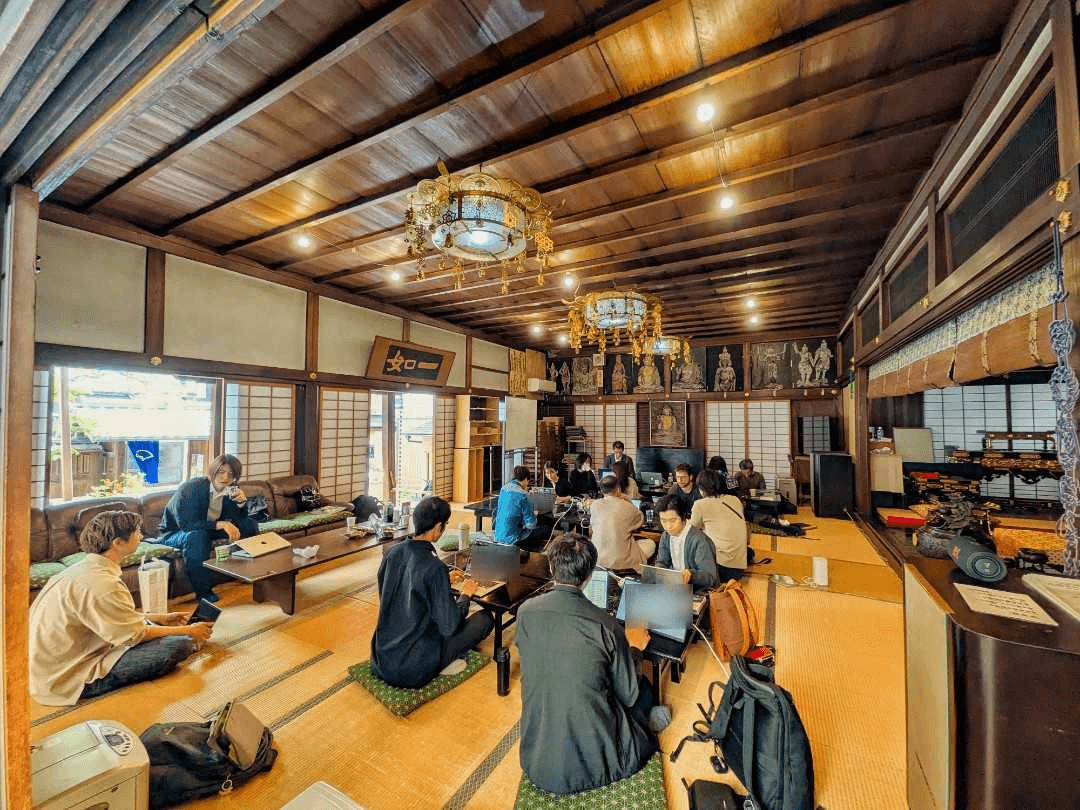
Since February 2019, this general Kyoto community has held more than 164 co-working sessions, networking events, lightning-talk events, and hands-on workshops over 7 years and grown to 647 connpass members. Its temple, machiya, and coworking venues are characteristic of Kyoto, and it welcomes people across technical fields. It holds one or two events monthly, recently including a book-reflection session, co-working, and an introduction to quantum computing.
See Kyoto IT Engineer Communities for the local landscape and First-time Visitors for how attendance works.
- Best for: People seeking a recurring, technology-neutral community in Kyoto or Kansai
- Official information: connpass
Next events
Miyako de IT publishes current events on connpass. A co-working session works even if you only listen or work, making it suitable for a first visit.
11. Kyoto.js (Kyoto)
A community for JavaScript study groups around Kyoto, representative of the “city.js” regional-and-technology naming pattern. It also communicates through Slack. Recent meetings have continued at roughly an annual pace, including Kyoto.js 24 in November 2025.
- Best for: JavaScript and frontend developers around Kyoto
- Official information: connpass
12. Kanazawa.rb (Kanazawa)
A small regional Ruby community for anyone interested in Ruby or beer, based in and around Kanazawa. It holds a mainly co-working meetup around the third Saturday each month and reached meetup 167 by July 2026. It uses Doorkeeper.
- Best for: Hokuriku engineers, Ruby enthusiasts, and people seeking a monthly rhythm
- Official information: Official site / Doorkeeper
13. Sugoi Hiroshima (Hiroshima)
An IT co-working community held every Wednesday in Hiroshima. It had exceeded 650 sessions by December 2025. Participants register through GitHub pull requests, and remote “air participation” is supported. Reading, exchanging information, and individual work are all acceptable.
- Best for: Hiroshima engineers and people who want a weekly working rhythm
- Official information: Official site / connpass
14. Engineer Cafe (Fukuoka)
A facility created by Fukuoka City as part of Engineer Friendly City Fukuoka and operated through public-private collaboration; Engineer Cafe is its proper name. It opened in Fukuoka City Red Brick Culture Hall in August 2019 and, according to the city, passed 100,000 cumulative users by June 2025. In addition to coworking and hackerspace use, it offers study groups, workshops, and career consultations, with edge-runtime and quantum-circuit programming events in July 2026.
- Best for: Fukuoka engineers who want to encounter community through a place first
- Official information: Official site / connpass
15. Sapporo Engineer Base (Sapporo)
An operator-run Sapporo community pursuing a city where engineers gather, grow, and thrive. It continues co-working sessions, career talks, and meetups, with events including SAPPORO ENGINEER BASE #15 scheduled in July 2026.
- Best for: Engineers in Sapporo and Hokkaido seeking career information exchange
- Official information: connpass
How to find regional communities beyond these six
Cities nationwide have continuing communities. Search connpass for “city + co-working study session” or “city + study group,” or for regional-technology names such as “city.rb” and “city.js.” To launch one yourself, see How to Start an IT Community in a Regional City; The Complete Guide to IT Communities provides the broader search framework.
Getting started—four steps to a first visit
Step 1: Create a connpass account
Many Japanese IT communities recruit through connpass, though some use Doorkeeper or Luma. Search by technology and region, then join a community's group page for new-event notifications. Choosing Between connpass, Doorkeeper, and Meetup compares platforms.
Step 2: Choose “listening only is welcome” or a co-working session
Lower the barrier by choosing a format without required speaking. A seminar or a session where everyone advances their own task is complete through attendance alone. Look for “first-timers welcome” and “listening only is welcome.”
Step 3: Register and arrive at the organizer's specified reception time
Most events are free. Reception times vary, so follow the event page rather than a universal rule. Arriving slightly early creates time to tell an organizer that it is your first visit, allowing them to guide or introduce you.
Step 4: Do not judge after one visit; return and assess fit
Attend the same community several times. Faces, names, and conversation openings grow with each visit. If it still does not fit, simply try another; there is no reason to feel guilty about leaving.
For a first step in Kyoto or Kansai, try a Miyako de IT co-working session.
Taking a first step in Kyoto
Miyako de IT holds co-working and networking events once or twice monthly in Kyoto. First-time Visitors explains what to expect.
Frequently asked questions
Q. Does participation cost money?Most regular study groups and co-working sessions are free. If drinks, a social gathering, or venue expenses require payment, the event page states it in advance. Large conferences such as Vue Fes Japan and JAWS DAYS may require tickets.
Q. Can I belong to multiple communities?Yes. A nationwide specialist community plus a regional community in your daily area is a practical combination of learning and continuity—for example, building a work rhythm at a local co-working session and traveling to specialist conferences several times a year.
Q. Should I begin online or in person?Both have advantages: online reduces travel, while in-person events are more memorable and build familiarity faster. One sequence is to learn the atmosphere through hybrid communities such as IoTLT or Kubernetes Meetup Tokyo, then attend a regional community in person. Include some face-to-face participation to support motivation.
Update history
- August 5, 2026: added the listing criteria; added the date of the last check against official primary sources; stated how the nationwide, Kansai, and Kyoto listing articles divide the subject between them
- July 11, 2026: rechecked the major official pages
- July 10, 2026: verified each group's listed facts against primary sources
Update policy
Community activity, URLs, and participation conditions change. The facts here were checked against primary sources including official sites, connpass, and municipal announcements on July 10, 2026; the major official pages were rechecked on July 11, 2026; and the listing criteria were applied and the main pages checked a final time on August 5, 2026. The verification date for each group is as given above, and it differs from group to group. Future reviews will re-fetch primary sources, not rely on search-engine recrawls, and will give priority to each group's official information. Numbers include acquisition dates and are not used to rank scale. We conduct a full annual review, accept corrections from operators, and retain a change history.
Conclusion
Choosing by learning, networking, speaking, or region reveals a suitable community. All 15 listed here had verifiable activity in 2025–2026. Create a connpass account and register for one listening-welcome event or co-working study session.
Related articles
- The Complete Guide to IT Communities (2026) — Foundations and selection theory
- Kansai IT Engineer Communities and Study Groups — City-by-city tendencies in Kansai
- Kyoto IT Engineer Communities — Kyoto's purpose-based list
- Choosing Between connpass, Doorkeeper, and Meetup — Comparing event platforms
- How to Start an IT Community in a Regional City — Launch and continuity
- Remote IT Engineer Loneliness and Five Responses — For people considering participation for connection
Related articles
The Complete Guide to IT Engineers in Kyoto: Salaries, Career Changes, Work Styles, and Communities (2026 Edition)
A guide to working, changing jobs, and learning as an IT engineer in Kyoto. Drawing on more than 7 years of operating an IT engineer community in Kyoto, this page organizes the whole local IT landscape: major company categories, salary levels, the job market, career paths, communities, work environments, and places to live.
Kyoto Mokumoku Sessions: Temple Reports, Participation, and How to Find One
A hub for Kyoto mokumoku sessions, connecting participation guidance, the effects of repeated attendance, reports from temples and other venues, and practical answers based on 164 Miyako de IT events.
An IT Community Guide for Students, Beginners, and First-Time Participants
“Will I be out of place?” Almost everyone feels anxious before joining an IT community. Drawing on the experience of operating a Kyoto community with 647 members, this guide explains how students, beginners, and first-time participants can take a comfortable first step. You can find a place regardless of experience or title.
Source data
The figures cited in this article are based on primary data in the Miyako de IT annual statistics report. It publishes yearly event counts, venue distribution, and event-format data.
Written by
Miyako de IT Editorial Team
Open event related to this article
 Waitlist
Oct 31 (Sat)
Original event title