
Finding IT Study Groups in Kyoto
A first-time guide to choosing the right format
If you are looking for an IT study group in Kyoto, start by deciding what you want to do. Choose the closest goal—learn, make progress on your own work, present, or talk with people—then check the event format and participation conditions.
This article covers how to search for and choose IT events in Kyoto. Current sessions are on the event listing, community-by-community comparison is on the Kyoto IT engineer community guide, and the day-of flow for first-time visitors is on the first-time guide.
Start with your goal
| Your goal | Formats that may fit | Check before registering |
|---|---|---|
| Learn a new topic | Themed study group or hands-on workshop | Prerequisites, preparation, what to bring |
| Make progress on your own work | Mokumoku session | Power, Wi-Fi, arrival/departure rules, work time |
| Try a short presentation | Lightning-talk event | Talk length, topic, whether listening-only is allowed |
| Talk with people | Networking or social event | Intended participants, conversation time, code of conduct |
Do not choose from the format name alone. Check the target audience, flow, fee, and venue conditions on the individual event page.
Three routes for finding IT study groups in Kyoto
1. Search event platforms
On platforms such as connpass, combine the region with the subject or format you want. Queries such as “Kyoto Python,” “Kyoto generative AI,” or “Kyoto mokumoku” make it easier to narrow the candidates.
Miyako de IT's sessions currently open for registration are collected on the event listing. We do not hard-code changing dates into this evergreen article.
2. Check each community's official page
Once you find a group that interests you, check its official website or event page for recent history. Past events help you judge topics, intervals, venues, and conditions.
To compare groups whose activity we could verify in Kyoto, see the Kyoto IT engineer community guide, which records official URLs, audience, format, and verification date.
3. Check announcements from venues, universities, and regional hubs
In Kyoto, temples, machiya townhouses, university facilities, coworking spaces, and other local venues sometimes host IT events. Official announcements from those places are another route.
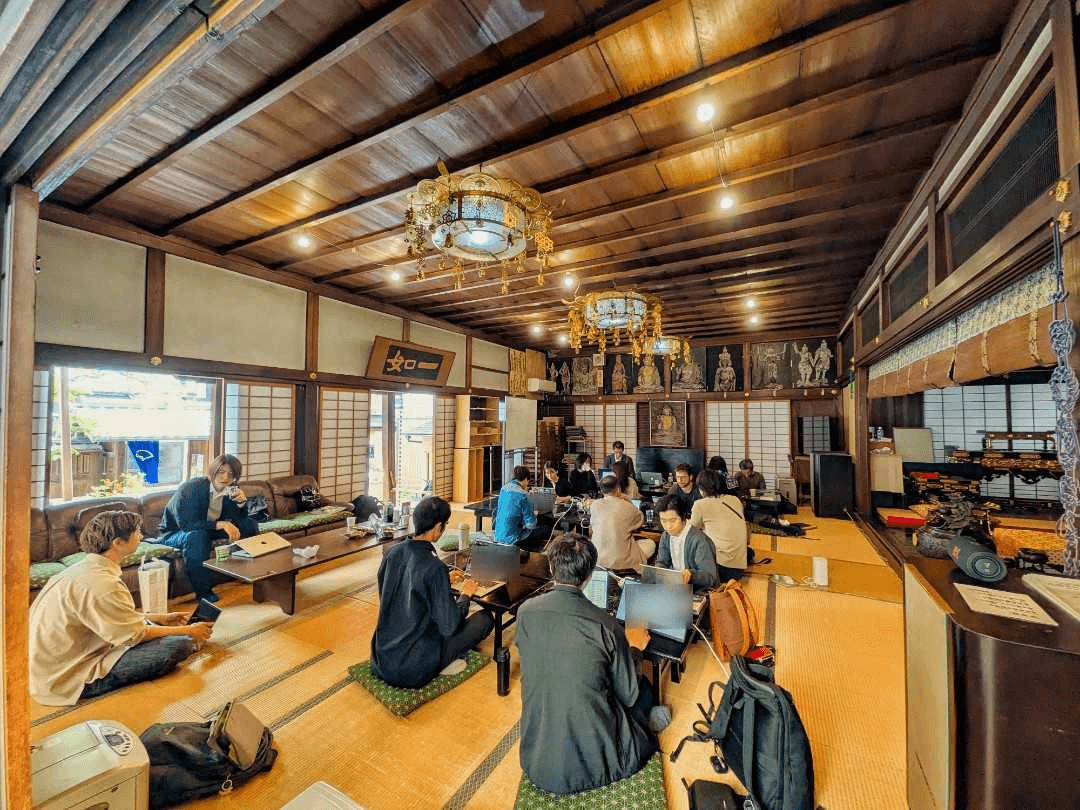
Miyako de IT has also used several kinds of venues, including temples and a soba restaurant in a former ochaya building. Choose for the event's purpose and how you want to spend the time, not just for novelty.
How the main formats differ
Mokumoku session
Participants each bring their own task. What you work on, whether late arrival or early departure is allowed, and whether there is social time vary by event.
For the first-time registration flow and what to bring, see What is a mokumoku session?.
Themed study group
A talk or lecture focuses on one technology or subject. Some sessions define prerequisites, so check the listing.
Lightning-talk event
Several participants give short presentations. Whether listening-only is allowed and whether speakers register separately depends on the event.
Hands-on workshop
Participants operate their own computers while following instructions. Check required software, accounts, and advance setup.
Networking event
Conversation is the main activity. Check the intended audience, rules on solicitation, and the code of conduct.
Five things to check before a first visit
1. Audience — beginners, students, practitioners, or other conditions
2. Format — listening, working, presenting, or conversation
3. Venue conditions — power, Wi-Fi, shoes-off rules, and other practical details
4. Time and entry rules — start/end time and how late arrival or early departure is handled
5. Fee and registration — the latest terms on the event page
Whether an event welcomes beginners or solo participants should also be confirmed on that event's listing rather than generalized to every study group.
When you want to compare communities in Kyoto
If you are choosing by community rather than by event format, use the Kyoto IT engineer community guide.
It uses common fields—official URL, main themes, intended participants, format, activity verification date, and first-visit route—and does not treat listing order as a ranking.
For a region-independent explanation of community types, use the complete IT community guide.
If this is your first Miyako de IT event
Current sessions are on the event listing. Reception, what to bring, and how to enter the venue are covered by the first-time guide.
For mokumoku sessions specifically, the Kyoto mokumoku guide lets you browse by venue and series.
Next step
If you want to attend an IT study group in Kyoto, start with the current event listing.
If you have not chosen a format yet, return to the table above and pick the goal closest to what you want to do now—learn, make progress, present, or talk with people.
To browse Miyako de IT by series or venue, use the Kyoto IT study-group and mokumoku hub. For first-visit concerns, see the first IT study group guide. To see an actual record covering several formats and venues, read the Kyoto summer community events report.
Related articles
Kyoto Mokumoku Sessions: Temple Reports, Participation, and How to Find One
A hub for Kyoto mokumoku sessions, connecting participation guidance, the effects of repeated attendance, reports from temples and other venues, and practical answers based on 164 Miyako de IT events.
Designing an IT Study Group: Mokumoku, Reading, Lightning Talks, and Hands-on Formats
A guide for organizers choosing among four repeatable study-group formats and turning one into a monthly series, based on 7 years and more than 164 events in Kyoto.
Miyako de IT Holds a Mokumoku Session and Rooftop BBQ at Fushigi na Yado
On May 29, 2026, Miyako de IT held a two-part event at Fushigi na Yado in Kyoto: a seven-person afternoon mokumoku session in the lobby and a 17-person rooftop BBQ for engineers, designers, communications professionals, and creators.
Source data
The figures cited in this article are based on primary data in the Miyako de IT annual statistics report. It publishes yearly event counts, venue distribution, and event-format data.
Written by
Miyako de IT Editorial Team
Open event related to this article
 Waitlist
Oct 31 (Sat)
Original event title