
Kyoto IT Community List
With activity verification dates and first-visit routes
Activity data last verified: August 2, 2026
This article is based on primary sources such as official websites and event pages. The September 20, 2026 rewrite reorganized how to read the comparison and the calls to action; it does not claim that every group's activity was re-verified on September 20.
Listing order is not a ranking. Schedules, venues, fees, and registration conditions may change, so check the official page before joining.
When choosing an IT community in Kyoto, the first question is not “which one is best?” It is what you want to do, and what current activity you can verify from the group's official page.
This article compares groups whose activity we could verify using the same fields:
- official URL
- main themes
- intended participants
- event format
- activity verification date
- primary source checked
- first-visit route
It does not rank groups, evaluate superiority, claim exhaustive nationwide coverage, or assert current availability from old event records.
If you want to search by event format, use How to Find IT Study Groups in Kyoto. For community types without a Kyoto constraint, use the Complete IT Community Guide. Current Miyako de IT sessions are on the event listing.
How groups were selected and verified
This article was produced through the following procedure. We prioritized leaving the reader able to repeat the same verification.
- The listing order does not indicate ranking. Groups appear in alphabetical order of their official name, followed by Japanese alphabetical order. We do not rank or score them.
- The activity verification date is the date on which the editorial team actually opened each group's official page and checked its contents. Every entry was re-checked on August 2, 2026.
- The primary source we checked is the “next event” or “past events” section of a connpass group, or the event listing on an official website. We state for each group what we looked at.
- We do not describe a group as “active” when its activity cannot be confirmed. Groups whose recent events we could not confirm are recorded as they are in a separate section below.
- Absence from this article does not mean a group is inactive. This is a list of what the editorial team could verify. We welcome messages about additions and corrections.
- Fees, venues, and start times differ by group and by session. Rather than filling gaps with guesses, this article assumes you will check the official page before registering.
- We do not rely on reposts from other sites alone. We checked each group's own official page rather than aggregator sites or third-party write-ups.
- We check for closure, suspension, and relocation. Groups whose recent events we could not confirm are recorded as they are in a separate section below.
- We state whether listings can be paid for. This article has no paid listing slots. We do not decide whether a group is listed, or in what order, in exchange for payment.
- When we list ourselves or a related group, we state the role and the relationship. For the listing of Miyako de IT, which edits this article, we state its relationship with its operator, as described below.
---
How to read the eight listed items
Each group carries the following eight items. The first item, the community name, is the heading.
- Community name: the name as written on the official page.
- Official URL: the page we checked as a primary source.
- Main themes: the technical areas readable from the official description or from recent sessions.
- Intended participants: the audience the official description states explicitly.
- Event format: whether sessions are in person or online, and the type—study group, lightning talks, co-working, and so on.
- Activity verification date: the date the editorial team checked the official page.
- Primary source checked: the specific content confirmed on that date, such as the most recent session or an upcoming one.
- How to attend for the first time: what to do as a first step.
Seven further points to check before registering, beyond the items in this article
This article lists each group under eight items, but whether you actually register also depends on the following points. All of them can be checked on each group's official page. Rather than filling gaps with guesses, this article only shows you where to check.
| Point | Where to check it |
|---|---|
| A record of events held in Kyoto | The location of past events: held in Kyoto, online, or in another region |
| Regular or irregular | The interval between entries in the past-events section |
| Suitability for beginners | The intended-participants field on the listing, such as “first-time participants welcome” or “beginners welcome” |
| Whether students may attend | The registration types and fees on the listing, including whether a student slot exists |
| Whether online attendance is possible | The event format and registration types on the listing |
| The policy on soliciting and sales | The stated code of conduct or house rules. Miyako de IT declines participation whose purpose is sales or solicitation at an event |
| How to register | The intake route for each group, such as connpass, Doorkeeper, or an official form |
---
Communities whose activity we could confirm in Kyoto
First, the overall picture. The listing order does not indicate ranking.
| Community name | Main themes | Event format | Activity verification date |
|---|---|---|---|
| Digital Nomad Kyoto | International exchange and information for digital nomads staying in Kyoto | In-person networking events | 2026-08-02 |
| GDG Kyoto | Google technologies | Study groups, hackathons, and large conferences | 2026-08-02 |
| JAWS-UG Kyoto chapter | AWS | Study groups and lightning-talk events, both online and in person | 2026-08-02 |
| KOIN | Founding and startup support, open innovation | Seminars, workshops, and a consultation desk | 2026-08-02 |
| kyoto.go | Go | In-person lightning talks and online co-working sessions | 2026-08-02 |
| Kyoto.rb | Ruby | In-person meetups | 2026-08-02 |
| KyotoLT | Lightning talks with a theme set for each session | Weekday lightning-talk events | 2026-08-02 |
| Kyoto Agile Study Group | Agile and Scrum | Discussion, workshops, and book study | 2026-08-02 |
| Miyako de IT | Web, AI, Web3, developer tools, and regions and technology | Co-working, lightning talks, hands-on workshops, and networking | 2026-08-02 |
The details for each group follow.
Digital Nomad Kyoto
- Official URL: digitalnomadkyoto.com
- Main themes: information for digital nomads staying in Kyoto, and international exchange
- Intended participants: overseas remote workers staying in Kyoto, and people interested in international exchange
- Event format: in-person networking events, including sessions co-organized with other groups
- Activity verification date: 2026-08-02
- Primary source checked: we confirmed that the official website is published. However, we could not confirm any upcoming event dates on the group's own site. The activity check here rests not on the group's own page but on a co-organized session, "Miyako Mokumoku #61 with Digital Nomad Kyoto at Butsugenji" (scheduled for 23 August 2026, listed on mit.connpass.com). For the group's own standalone schedule, please check its official site.
- How to attend for the first time: check the community information on the official website, or register for a session co-organized with Miyako de IT
This is a point of contact for people who want to converse in English or encounter overseas software-development cultures.
GDG Kyoto
- Official URL: gdgkyoto.connpass.com
- Main themes: Google technologies; the official description calls the group a gathering of volunteers interested in Google technology
- Intended participants: people interested in Google-related technologies
- Event format: study groups, hackathons, and large conferences such as DevFest and Google I/O Extended
- Activity verification date: 2026-08-02
- Primary source checked: the most recent entry in the past-events section of the connpass group was “Google I/O Extended 2026 in Kyoto” (June 27, 2026).
- How to attend for the first time: follow the group on connpass and register for an announced session
The official description states explicitly that the group is independent of Google.
JAWS-UG Kyoto chapter
- Official URL: jawsug-kyoto.connpass.com
- Main themes: AWS; recent sessions have covered generative AI in DevOps, Bedrock, and CDK
- Intended participants: people who use AWS or want to learn it
- Event format: study groups and lightning-talk events, both online and in person
- Activity verification date: 2026-08-02
- Primary source checked: the next-event section of the connpass group listed “JAWS-UG Kyoto AWS Summer Lightning Talks” (August 6, 2026) and “AWS Expert Online for JAWS-UG #39” (September 16, 2026).
- How to attend for the first time: register for the next event on connpass
KOIN (Kyoto Open Innovation Network)
- Official URL: open.kyoto
- Main themes: founding and startup support, open innovation, applying generative AI, and programs for students
- Intended participants: people who want to start, grow, or support a business, according to the official description
- Event format: seminars, workshops, a consultation desk, and meetups; a facility based on the third floor of Kyoto Economic Center
- Activity verification date: 2026-08-02
- Primary source checked: the EVENT page of the official website listed several sessions scheduled from August 3, 2026 onward.
- How to attend for the first time: register for a session of interest from the EVENT page of the official website
KOIN is a place rather than a group. According to the official description, it is the name of the open-innovation cafe on the third floor of Kyoto Economic Center, operated by the Kyoto Industrial Creation Forest, a general incorporated association established by Kyoto Prefecture, Kyoto City, and the Kyoto business community. It is an entrance for people interested less in technology itself than in how technology and business move within the Kyoto region.
kyoto.go
- Official URL: kyotogo.connpass.com
- Main themes: the Go language
- Intended participants: people who want to learn Go regardless of technical level or knowledge, according to the official description
- Event format: in-person lightning talks combined with online co-working sessions
- Activity verification date: 2026-08-02
- Primary source checked: the most recent entry in the past-events section of the connpass group was “Kyoto.go remote #66,” a co-working session for finishing a proposal (June 13, 2026).
- How to attend for the first time: follow the group on connpass; the official description also points to a Kyoto channel in Gophers Slack and a Discord server
Kyoto.rb
- Official URL: kyotorb.connpass.com
- Main themes: Ruby
- Intended participants: Ruby engineers in and around Kyoto City; the official description states that participants from outside Kyoto City are welcome
- Event format: in-person meetups where hacking, presenting, and discussion are all open
- Activity verification date: 2026-08-02
- Primary source checked: the next-event section of the connpass group listed “Kyoto.rb Meetup OSS Gate” (August 29, 2026). The most recent past session was “Kyoto.rb Meetup” (July 25, 2026).
- How to attend for the first time: register for the next event on connpass
KyotoLT
- Official URL: kyotolt.connpass.com
- Main themes: lightning talks with a theme set for each session; recent themes include AWS and AI
- Intended participants: people who want to attend or present in a relaxed setting, according to the official description
- Event format: weekday lightning-talk events
- Activity verification date: 2026-08-02
- Primary source checked: the most recent entry in the past-events section of the connpass group was “KyotoLT #34” (May 29, 2026). The official description states that the group has met on weekdays in Kyoto since April 2012.
- How to attend for the first time: follow the group on connpass and register either to listen only or for a speaking slot
Kyoto Agile Study Group (#KyoAja)
- Official URL: kyoaja.connpass.com
- Main themes: Agile and Scrum; a book study has continued recently
- Intended participants: people practicing Agile and Scrum, or preparing to practice them, according to the official description
- Event format: discussion, workshops, and book study
- Activity verification date: 2026-08-02
- Primary source checked: the most recent entry in the past-events section of the connpass group was “Kyoto Agile Study Group #131” (June 12, 2026).
- How to attend for the first time: follow the group on connpass and register for an announced session
Miyako de IT (MIT)
- Official URL: mit.connpass.com
- Main themes: web applications, AI, Web3, blockchain, developer tools, and regions and technology
- Intended participants: engineers, designers, founders, students, and people from companies and government, according to the official description; the official description also states that people outside engineering and people who have just started learning about IT can take part
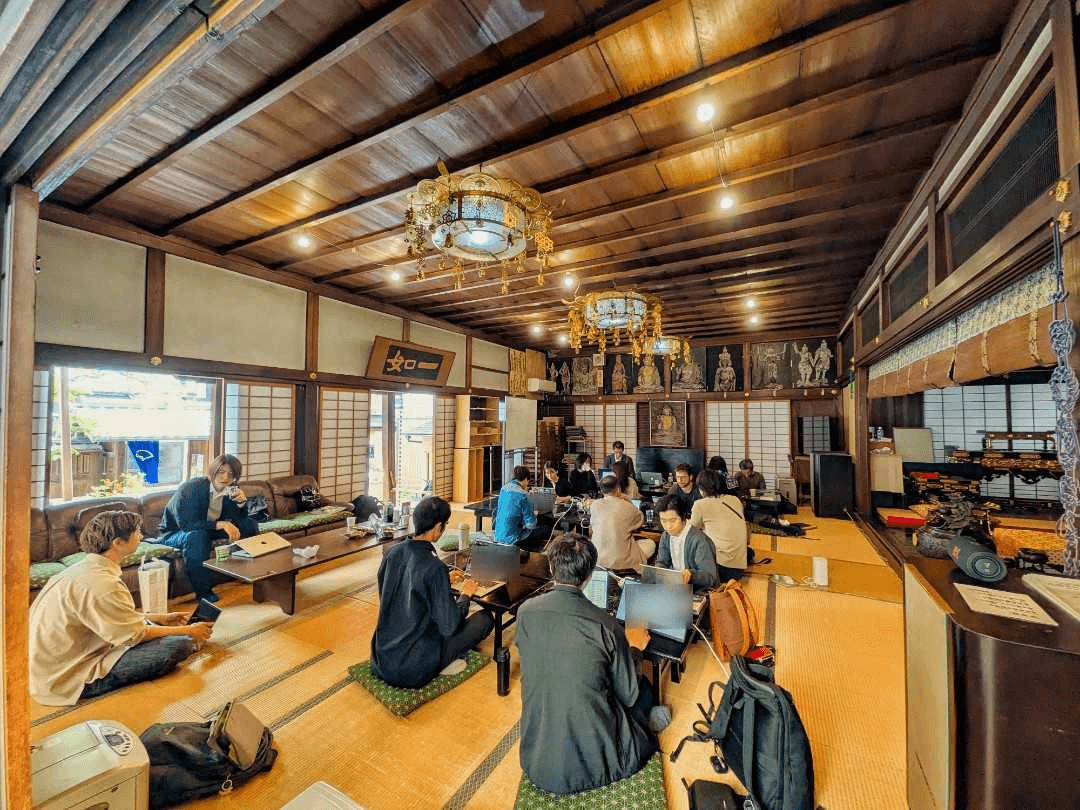
- Event format: co-working sessions, lightning talks, hands-on workshops, and networking events, mainly at temples, machiya townhouses, university facilities, and regional venues
- Activity verification date: 2026-08-02
- Primary source checked: the next-event section of the connpass group listed several sessions between August 8 and September 5, 2026.
- How to attend for the first time: choose from the list of currently recruiting events, or read the first-time guide for how a session runs
Miyako de IT, which edits this article, is listed as one of the groups using the same items. Founded in Kyoto in February 2019, it counts 164 completed events over 7 years (as of 2026-10-12, from connpass public data). Registered connpass members number 647, which is a count of registrations rather than of actual attendees.
Relationship with the operator: since 2025, Miyako de IT has been run as an official business of Netsujo Inc. (Shimogyo Ward, Kyoto). Because this article is edited by that Miyako de IT editorial team, we state in advance that we include our own group among the listings and that we do not rank it against other groups.---
Groups whose recent activity we could not confirm as of August 2026
We checked the official pages of the following group but could not confirm any recent sessions. It may have resumed, or it may be active somewhere other than connpass. Please check the official page for the latest information.
- E-Ripple (Kansai Student Engineer Community): kansai-eng-net.connpass.com (verified 2026-08-02). The connpass group listed four public events, the most recent of which ended on February 17, 2024. As of August 2026 we could not confirm any recent session.
For students, a practical approach is to combine a university club or research group with events in Kyoto and Kansai that are mainly attended by working professionals. Several of the confirmed groups above hold sessions that welcome students.
---
Three things to check when choosing a community in Kyoto
After reviewing the list, check these three items on each group's official page.
1. Does the current theme match your purpose?
Look at recent event themes and formats rather than choosing from the group name alone. The right choice differs depending on whether you want to deepen a technology, give a lightning talk, reserve focused work time, or talk with people.
2. Can you actually join under the current conditions?
Dates, venues, online availability, fees, intended participants, and first-time registration options vary by event. This article does not fill changing values with estimates.
3. Is the verification date still recent enough?
The group data in this article is based on primary sources checked on August 2, 2026. The September 20 rewrite did not re-verify every group. Always check the official page for current sessions before registering.
You may use several communities for different purposes. This is not a ranking for selecting one winner; it is a map for reaching official information.
Next step
- Compare groups → use the official links in this list
- Search by event format → How to Find IT Study Groups in Kyoto
- See current Miyako de IT sessions → Event listing
- Prepare for a first visit → First-time guide
- Search across Kyoto, Osaka, and Kobe → Kansai IT Engineer Community and Study Group Guide
Update history
- September 20, 2026: clarified search-intent roles, rewrote how to read the comparison and the three decision checks, and reorganized CTAs; the August 2 activity verification record remains unchanged
- August 5, 2026: added the listing criteria; clarified how activity verification dates and primary sources are documented; added the points to check before registering; stated how the nationwide, Kansai, and Kyoto listing articles divide the subject between them; stated the relationship with the operator, Netsujo Inc.
- August 2, 2026: re-checked each group's official page and updated the activity verification dates.
To start with a Miyako de IT session, the list of currently recruiting events collects the sessions you can join now. For how a session runs and what to bring, see the first-time guide.
Related articles
An IT Community Guide for Students, Beginners, and First-Time Participants
“Will I be out of place?” Almost everyone feels anxious before joining an IT community. Drawing on the experience of operating a Kyoto community with 647 members, this guide explains how students, beginners, and first-time participants can take a comfortable first step. You can find a place regardless of experience or title.
"Talking with people outside the company is more fun": why manufacturing engineer Matsuura has attended Miyako de IT for two to three years
We asked Matsuura, an engineer who maintains and develops equipment control and Windows software in manufacturing, what first brought them to Miyako de IT, why they have kept coming for two to three years, what makes the community feel open to first-time participants, and what they would like to try next in terms of lightning talks and helping run events.
15 Active IT Engineer Communities to Join in 2026
A catalog of 15 communities for IT engineers—nine nationwide and six regional. Compiled from 7 years and 164 events of community operations in Kyoto, it covers choosing by learning, networking, speaking, or region; four steps to a first visit; and common questions. This is not an exhaustive nationwide list. The order is not a ranking, and each community's activity was checked against primary sources such as official sites and connpass.
Source data
The figures cited in this article are based on primary data in the Miyako de IT annual statistics report. It publishes yearly event counts, venue distribution, and event-format data.
Written by
Miyako de IT Editorial Team
Open event related to this article
 Waitlist
Oct 31 (Sat)
Original event title