
An IT Community Guide for Students, Beginners, and First-Time Participants

An IT Community Guide for Students, Beginners, and First-Time Participants
“Is it okay to go when I have so little experience?” “Will it be awkward if everyone uses terminology I do not understand?” Many people share these worries before joining an IT community. The direct answer is that you can find a place in a community regardless of your experience or title.
Key points
- First-time anxiety is universal. You can find a place regardless of experience, education, or title.
- A safe entry point is an event that does not require a presentation or networking, such as one marked “listening only is welcome” or a co-working study session.
- Participants include students, beginners, humanities graduates, and career changers. Many attend alone.
- The value is not only knowledge, but also people you can consult and a reason to keep learning. After the first three visits, the community is more likely to feel like a place where you belong.
What this article answers is limited to the question of whether you are entitled to attend at all. The classification of communities—co-working sessions, lightning-talk events, hackathons—and the seven criteria for choosing one are handled by The Complete Guide to IT Communities. Start there if you want to compare types first.
Feeling anxious is normal
Even veterans were once nervous first-time participants. Feeling that you may be out of place can also be evidence that you are taking the event seriously. The most effective first move is to attend just once while accepting that anxiety.
Who actually attends?
Since Miyako de IT began in 2019, more than 647 members have joined. They include working engineers, designers, students, people learning without prior experience, freelancers, and company executives. It is not a closed circle only for engineers, but a loosely connected place for people interested in technology.
A first step for each situation
- Students — Find people to consult about careers and technology. An event explicitly welcoming students is an easy entry point.
- Beginners and learners — Start with “listening only is welcome” or independent study at a co-working session. Note unfamiliar words and look them up later.
- Working adults attending for the first time — Preparing a business card or social-media account makes it easier to keep the connections you make.
What you gain from a community
Technical knowledge is not the only benefit. Over time, the following benefits centered on people often matter more.
- People you can consult — When you are stuck, you can receive practical advice with context that is hard to find online.
- A reason to continue — Learning that is easy to abandon alone becomes easier when familiar faces are present.
- More career options — Talking with people who work in different ways broadens your view of possible paths.
- A place to share — Once comfortable, you can take a first step toward speaking through a lightning talk. See the complete guide to giving your first LT.
How to identify a welcoming event
Events explicitly marked “beginners welcome,” “listening only is welcome,” or “co-working study session” are suitable first steps. The first-time IT study-group manual covers participation and etiquette, while the guide for people afraid to attend a networking event alone addresses that particular worry. After three visits, faces and names begin to match and the place naturally becomes familiar; see the real value that begins with three visits.
Where to look in Kyoto
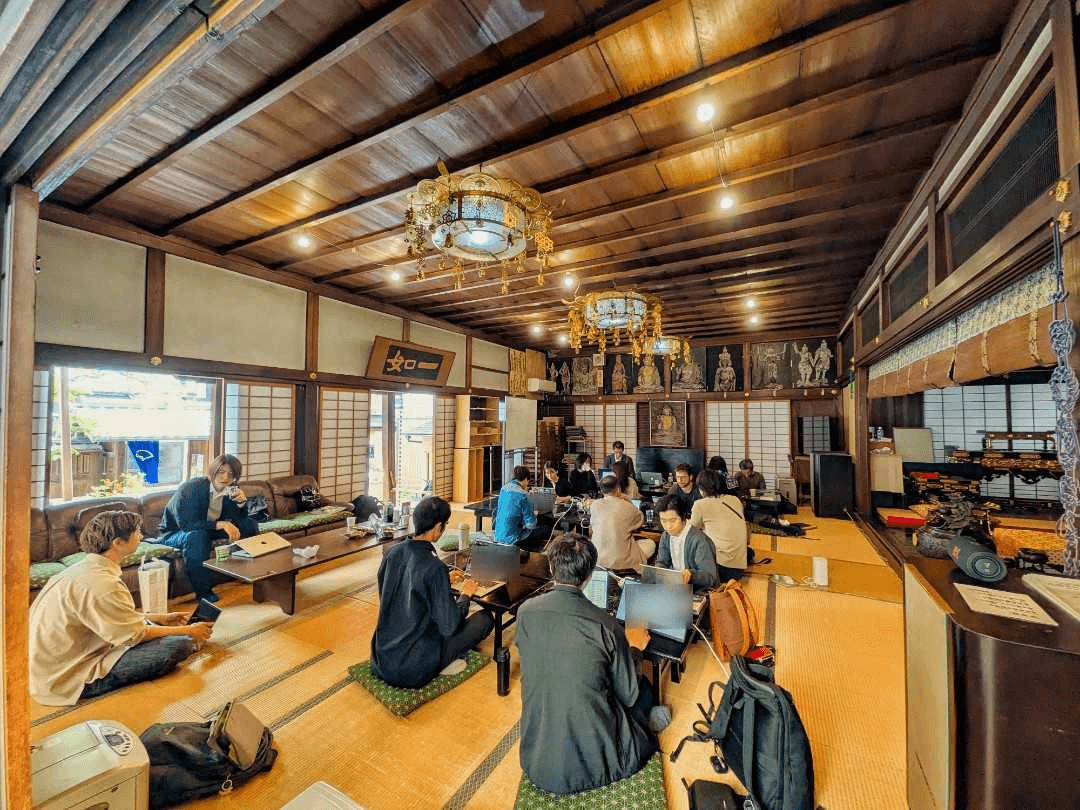
In Kyoto, Miyako de IT's co-working study sessions are one accessible entry point. At calm venues such as temples and machiya townhouses, participants work independently and interact at an easy pace. See how to join a co-working study session and why new-graduate engineers should join a community.
If this will be your first Miyako de IT event, also review the first-time participant page, which explains the event-day flow, venue atmosphere, and frequently asked questions.
Related articles
Your First Lightning Talk: A Complete Guide to Choosing a Five-Minute Topic, Making Slides, and the Day-of Flow
A complete guide for people who want to try a lightning talk at a study group. Learn how to choose a five-minute topic, structure slides, prepare for the day, and handle nerves, based on a Kyoto community's experience supporting many first-time speakers across 164 events.
Kyoto IT Engineer Communities: Activity Dates and How to Join
A comparison of IT communities whose activity we verified in Kyoto, using the same fields: official URL, themes, intended participants, format, verification date, primary source, and first-visit route. Listing order is not a ranking. Activity data was last verified on August 2, 2026; check each official page again before registering.
What Is a Mokumoku Session? Meaning, How to Join, and What to Bring
A mokumoku session is an event where people gather in the same place or time and each advance work of their own. This guide explains the format, how to find and register for a session, what to bring, and what to check before attending.
Source data
The figures cited in this article are based on primary data in the Miyako de IT annual statistics report. It publishes yearly event counts, venue distribution, and event-format data.
Written by
Miyako de IT Editorial Team
Open event related to this article
 Waitlist
Oct 31 (Sat)
Original event title