
Regional Communities Win through Theme Design: Giving Local Context Meaning
People starting a regional IT community often ask, “What theme should we choose?”
The practical answer is: choose a theme that only makes full sense in that region.
This article develops T for Theme from the TEMPLE model for regional IT community operations, based on seven years, 164 events, and 647 Miyako de IT members.
A region's disadvantage is density; its strength is context
Tokyo can support many simultaneous technical events. Kyoto has far fewer. A regional community cannot win through matching efficiency alone.
It can use context:
- Kyoto: a 1,200-year city, temples, universities, and traditional crafts.
- Kanazawa: a castle town, a gateway to Hokuriku, and craft culture.
- Fukuoka: a connection with Asia and startup policy.
Success depends on converting that context into a meaningful theme.
Miyako de IT examples
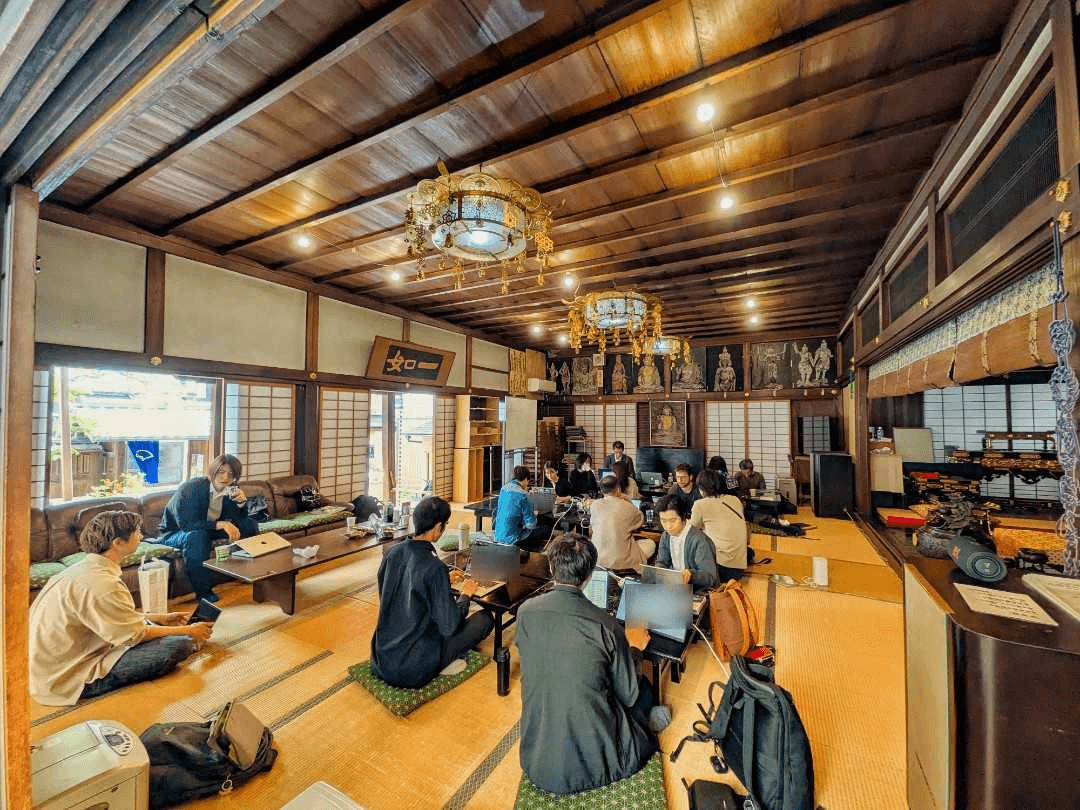
Mokumoku sessions at temples
Butsugenji has hosted recurring sessions since 2024. People come partly for the experience of writing code in a Kyoto temple.
Sessions in traditional townhouses
Kokando, Kanata Konata, and Takahashi each make the building part of the event's identity.
Academia–industry events
Work with Taisho University Kyoto Academia and Kyoto Chiesangyo Sozonomori turns Kyoto's concentration of educational institutions into a community strength.
International exchange
Co-hosting with Digital Nomad Kyoto connects local engineers with international residents drawn to Kyoto.
Three principles
Find meaning that arises from the place
Connect technology with something local people value. It need not be a famous visitor attraction.
Do not redesign every event
Overly elaborate monthly themes exhaust organizers. Establish a repeatable base format, such as a temple mokumoku session, and refine it.
Describe the theme consistently
Use the same language across the group description, event title, and social posts. Consistent references to Kyoto, temples, and townhouses also help discovery.
Common failures
- Following technology trends alone: a generic AI, Web3, or quantum event competes directly with much larger cities.
- Choosing only convenience: an ordinary room near a station may be useful but forgettable.
- Designing around one organizer's narrow interest: a regional audience can be exhausted quickly.
Conclusion
Regional differentiation comes from connecting technology with the context of the place. Choose a theme that belongs there, repeat a sustainable format, and communicate it consistently.
Related articles
- TEMPLE Model for Regional IT Community Operations
- Continuing IT Study Sessions at Butsugenji
- Regional IT Engineer Career Strategy
- How to Start and Continue an IT Community
For consultation about starting a community outside Kyoto, use Netsujo Inc.'s contact form (Japanese) or see the founder profile.
Related articles
When a Venue Becomes a Brand: Why We Hold IT Events in Kyoto Temples and Townhouses
Seven years of Miyako de IT operations show how repeated use of temples, townhouses, coworking spaces, and universities can turn a venue into a community asset.
Lessons from Running a Regional IT Community: What 164 Kyoto Events and 647 Members Showed About Continuing (2026)
A record of 7 years running a regional IT community in Kyoto, from 2019 to 2026. It sets out, year by year, what worked and what did not through launch, moving online, differentiating by place, and becoming established. The definition of the TEMPLE model is kept in its own article.
What an IT Study Group Is Worth in the Generative AI Era: From Being Taught to Bringing Back Results
Generative AI has lowered the cost of obtaining technical information, so where does the value of an IT study group sit now? Drawing on Miyako de IT's own sessions in Kyoto on Claude Code, AI agents, AI video generation, and quantum computing, this article examines the shift from a place to be taught toward a place to bring back what people actually tried.
Source data
The figures cited in this article are based on primary data in the Miyako de IT annual statistics report. It publishes yearly event counts, venue distribution, and event-format data.
Written by
Tomohiro Iida
Open event related to this article
 Waitlist
Oct 31 (Sat)
Original event title