
IT Study Sessions at a Temple: Continuing Mokumoku Events at Butsugenji
Why a temple
The relationship began in April 2024 when organizers looked for a venue that felt specific to Kyoto rather than another cafe or coworking space, and the main hall has been in continuous use since. Butsugenji's priest immediately agreed to use of the main hall and was open to new technology and creative activity.
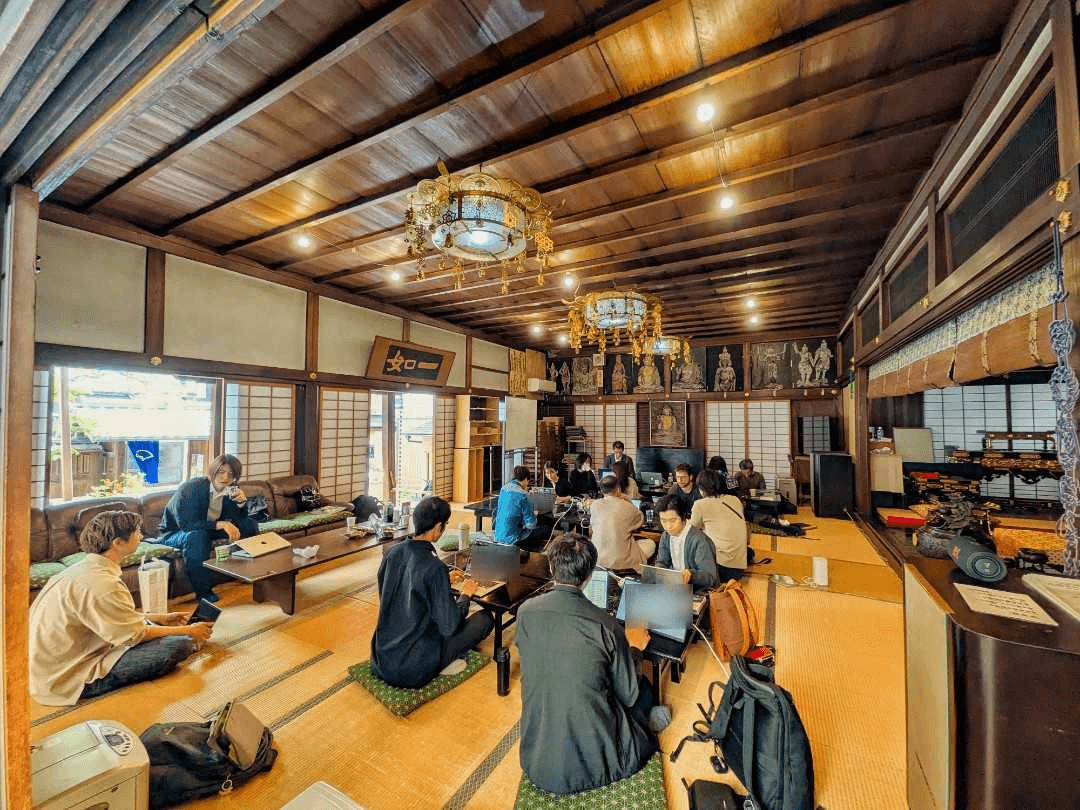
About five people joined the first experimental session, sitting with cushions on tatami and laptops. Instead of discomfort, participants most often reported that they could concentrate.
What the session feels like
- Remove shoes before entering the main hall.
- Choose a cushion or chair.
- Give a roughly one-minute introduction.
- Begin individual work.
- Break and talk about every two hours.
- Share progress at the end.
The wooden hall has a high ceiling and little outside noise. Seasonal air, birds, and occasional wind chimes replace cafe music.
Three reasons temples work
The space supports reflection
High ceilings, wooden beams, filtered light, and tatami create a quiet setting without cafe music or coworking conversation.
Arrival becomes a ritual
Traveling to the venue, passing through the gate, removing shoes, and entering the hall creates a physical switch into focused work, particularly for remote workers.
The venue communicates the community
Images of engineers working in a temple prompt questions and make the event memorable. That distinctiveness helped more people discover the community.
Participant responses
What follows is a summary of comments organizers heard on the day. No survey was run, so there is no sample size or percentage, and none of it is quoted from an identifiable individual. Please do not read it as an evaluation by participants as a whole.
Participants have reported greater concentration than during ordinary work, while some become sleepy sitting on tatami; organizers now provide both cushions and chairs. International engineers have responded especially strongly during events co-hosted with Digital Nomad Kyoto.
Other distinctive venues
- Kokando: a traditional townhouse with a calligraphy gallery and cafe.
- Takahashi: a former teahouse.
- Fushigi na Yado: accommodation used for focused development and social events.
- Taisho University Kyoto Academia: venue for mokumoku and generative-AI sessions.
Each differs, but they share the property of concentrating in a non-standard place. Satisfaction has not been measured, so we do not compare the venues against each other.
Advice for organizers
1. Speak directly with the priest and look for openness to new activity.
2. Explain the purpose and regional value clearly.
3. Respect rules for shoes, food, photography, and sacred areas.
4. Show an intention to continue rather than use the space once.
5. Return value through local contact, new visitors, and responsible communication.
This article covers the practical steps for the side that organizes the event. The Butsugenji venue-collaboration case separates what the event records confirm from what remains unconfirmed about acceptance conditions, facilities, and cost allocation. We do not present the venue's own decision process or view as a confirmed fact.
Conclusion
A venue is part of a community experience, not merely a container. Other regions can find their own equivalent in old houses, public baths, former schools, or shopping streets.
See Miyako de IT on connpass for future temple sessions. The Kyoto IT Community Whitepaper 2026 documents the complete event record and registration statistics.
Related articles
Kyoto Mokumoku Sessions: Temple Reports, Participation, and How to Find One
A hub for Kyoto mokumoku sessions, connecting participation guidance, the effects of repeated attendance, reports from temples and other venues, and practical answers based on 164 Miyako de IT events.
Lessons from Running a Regional IT Community: What 164 Kyoto Events and 647 Members Showed About Continuing (2026)
A record of 7 years running a regional IT community in Kyoto, from 2019 to 2026. It sets out, year by year, what worked and what did not through launch, moving online, differentiating by place, and becoming established. The definition of the TEMPLE model is kept in its own article.
Holding a Mokumoku Session at a Kyoto Temple: Creating a Place for Engineers to Focus
Opening laptops and writing code on tatami in Butsugenji's main hall: a first-party report on temple-based mokumoku sessions and why an unusual setting can help IT engineers focus.
Source data
The figures cited in this article are based on primary data in the Miyako de IT annual statistics report. It publishes yearly event counts, venue distribution, and event-format data.
Written by
Miyako de IT
Open event related to this article
 Waitlist
Oct 31 (Sat)
Original event title