
A Three-Part Introduction to Quantum Computing for IT Engineers
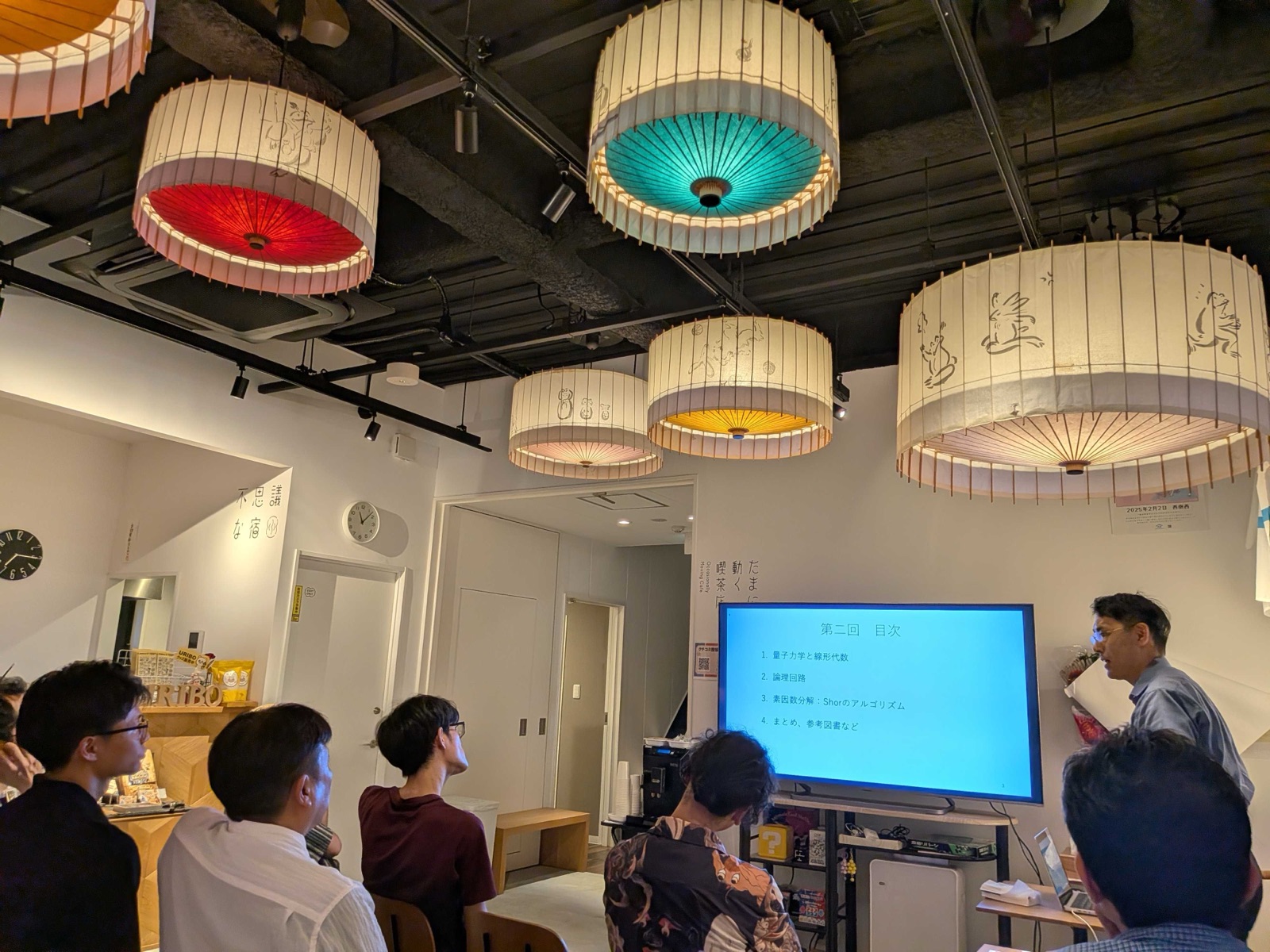
A Three-Part Introduction to Quantum Computing
Miyako de IT organized a three-session series to help IT engineers build a connected understanding of quantum computing. The program begins with physical and mathematical foundations, moves to quantum circuits and algorithms, and finishes with real hardware.
What the series teaches
The aim is not to memorize fashionable terminology. Participants learn what a qubit represents, how computation is expressed as a circuit, why interference matters, and where present-day devices differ from an ideal model.
Session 1: Why quantum computing?
The first session introduced the motivation for quantum computing and the concepts from quantum mechanics that distinguish it from classical computation.
Read the Session 1 report.
Mathematical preparation
Vectors, complex numbers, matrices, and inner products provide the minimum language needed to describe a one-qubit state and common quantum gates. A separate online preparation session reviewed these topics through diagrams and examples.
Read the mathematics preparation report.
Session 2: Circuits and Shor's algorithm
The second session compared classical and quantum circuits, explained why superposition is not ordinary parallel processing, and used Shor's factoring algorithm to show how interference can amplify useful outcomes.
Read the Session 2 report.
Session 3: Real quantum computers
The final session connects theory with implementation. It covers four approaches to building quantum computers, IBM quantum hardware, the effect of noise, and Grover's search algorithm.
Read the Session 3 report.
A practical learning path
1. Learn the physical intuition behind quantum states.
2. Review the minimum mathematics when notation becomes difficult.
3. Follow a one-qubit state through gates and measurement.
4. Study representative algorithms without treating them as magic.
5. Compare ideal circuits with noisy real hardware.
This sequence gives engineers enough structure to continue through books, simulators, and cloud quantum-computing services.
Related articles
Quantum Mechanics and Yoga: First Introduction to Quantum Computing for IT Engineers
On May 25, 2026, Miyako de IT held the first of a three-part quantum-computing series at Kokando. Physicist Tetsuya Onogi introduced why quantum computing matters, with yoga breaks led by Yuka Onogi.
How Quantum Computation Works: Quantum Circuits and Shor's Algorithm
Miyako de IT's second quantum-computing session covered qubits, quantum circuits, interference, and Shor's factoring algorithm, with short yoga breaks between technical sections.
Testing Noise and Grover Search on IBM Quantum Hardware: Session 3
On July 27, 2026, the third session in Miyako de IT's quantum-computing series compared four hardware approaches and sent Qiskit circuits to an IBM Quantum system.
Source data
The figures cited in this article are based on primary data in the Miyako de IT annual statistics report. It publishes yearly event counts, venue distribution, and event-format data.
Written by
Miyako de IT Editorial Team
Open event related to this article
 Waitlist
Oct 31 (Sat)
Original event title