
How Quantum Computation Works: Quantum Circuits and Shor's Algorithm
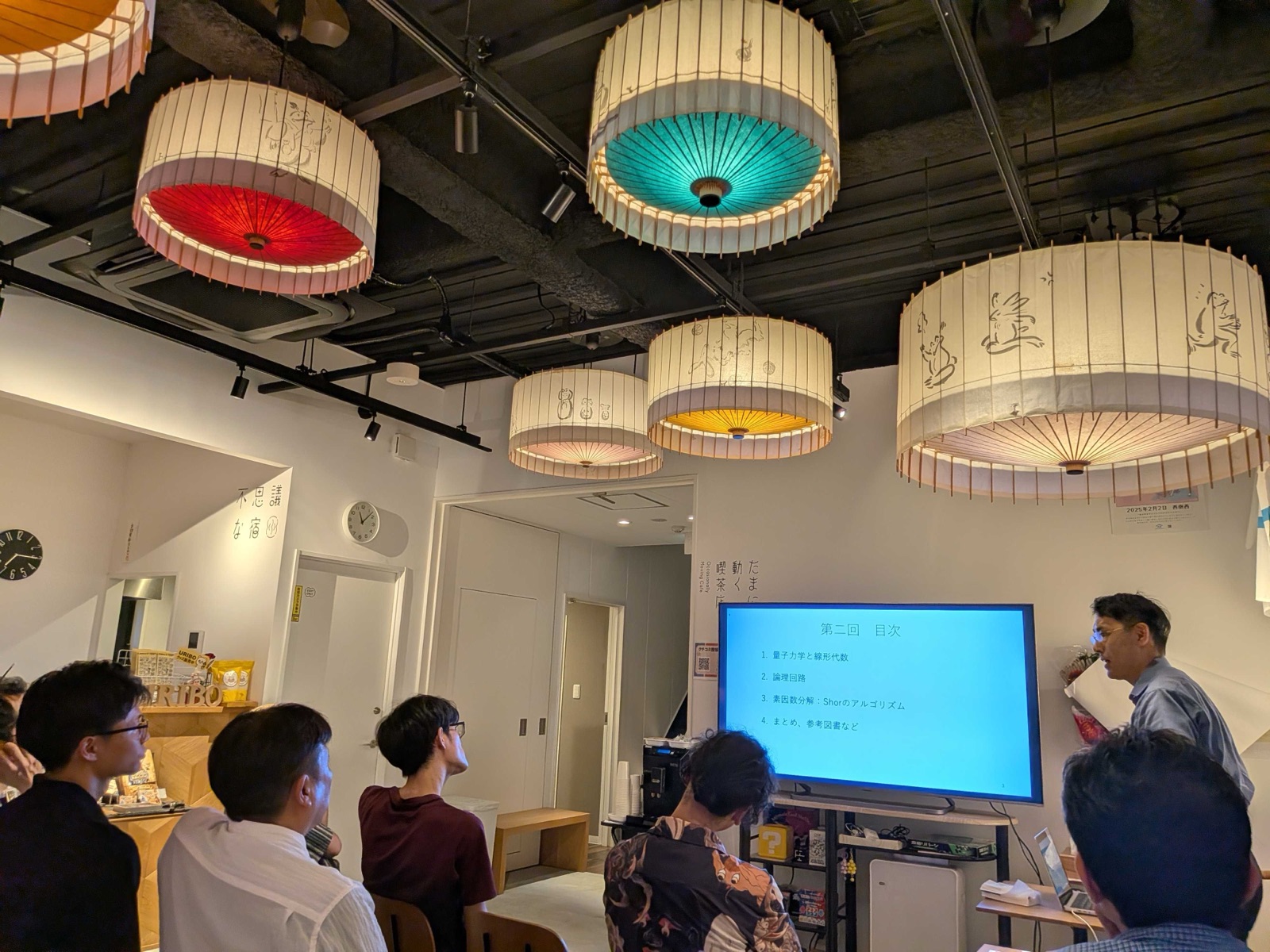
How Quantum Computation Works
On June 29, 2026, Miyako de IT held the second session in its three-part introduction to quantum computing. Tetsuya Onogi of Osaka University's Graduate School of Science guided participants from qubits and circuit notation to the central idea behind Shor's algorithm.
Event overview
| Item | Detail |
|---|---|
| Date and time | June 29, 2026, 7:00–9:00 p.m. |
| Venue | Fushigi na Yado |
| Address | 128 Hashizumecho, Shimogyo Ward, Kyoto |
| Lecturer | Tetsuya Onogi |
| Theme | How quantum computation works |
From quantum states to circuits
A qubit is represented as a vector whose amplitudes correspond to the classical states 0 and 1. A quantum circuit applies a sequence of gates to those qubits and then measures the result.
Classical and quantum circuits may look similar as diagrams, but their behavior differs. Quantum computation is not simply an enormous set of classical calculations running in parallel. Useful algorithms arrange interference so that incorrect states cancel while the probability of measuring a correct state grows.
Shor's algorithm and integer factorization
Shor's algorithm is a well-known example because it can factor integers efficiently on a sufficiently capable quantum computer. It converts factorization into a period-finding problem and uses the quantum Fourier transform as part of that process.
The essential lesson was not that quantum systems “try every answer at once.” The algorithm must create a structure in which interference amplifies useful answers. Quantum advantage therefore depends on both the problem and the algorithm.
Yoga as a learning interval
Short yoga intervals separated the specialist sections. They were not presented as having a scientific relationship to quantum computation; they gave participants a physical and attentional reset before returning to abstract material.
Three common misconceptions
- Quantum computers will not make every calculation faster.
- Superposition is not the same as ordinary parallel processing.
- Quantum computers will not replace every personal computer or server.
Their value is expected in selected problems for which suitable quantum algorithms exist.
Next session
The final session moves from theory to real quantum-computing hardware. See the series guide, the first-session report, and the mathematics preparation report.
Related articles
A Three-Part Introduction to Quantum Computing for IT Engineers
A guide to Miyako de IT's three-session quantum-computing series: foundations, quantum circuits and Shor's algorithm, implementation methods, IBM hardware, noise, and Grover's algorithm.
Quantum Mechanics and Yoga: First Introduction to Quantum Computing for IT Engineers
On May 25, 2026, Miyako de IT held the first of a three-part quantum-computing series at Kokando. Physicist Tetsuya Onogi introduced why quantum computing matters, with yoga breaks led by Yuka Onogi.
Testing Noise and Grover Search on IBM Quantum Hardware: Session 3
On July 27, 2026, the third session in Miyako de IT's quantum-computing series compared four hardware approaches and sent Qiskit circuits to an IBM Quantum system.
Source data
The figures cited in this article are based on primary data in the Miyako de IT annual statistics report. It publishes yearly event counts, venue distribution, and event-format data.
Written by
Miyako de IT Editorial Team
Open event related to this article
 Waitlist
Oct 31 (Sat)
Original event title