
Do Mokumoku Sessions Work? Three Effects and How to Sustain Them after 164 Events

What is a mokumoku session?
A mokumoku session is a study-group format where IT engineers and programmers gather but work quietly on separate tasks. It does not require a presentation or common curriculum. Development, study, writing, design, and other focused work are all valid.
For a complete participation guide and schedule, see What Is a Mokumoku Session?. This article focuses on the effects observed through 164 Miyako de IT events and 647 community members.
How it differs from other study formats
| Format | Main activity | Best suited to |
|---|---|---|
| Mokumoku session | Individual focused work with light exchange | Making progress on your own task |
| Themed study group | Listening to subject specialists | Structured information |
| Hands-on workshop | Following guided implementation | Learning a defined technique |
| Lightning talks | Several short presentations | Sharing and discovering ideas |
| Networking event | Conversation | Expanding relationships |
The format is not a substitute for teaching. Its value comes from creating an environment for work and repeated low-pressure contact.
How to participate
1. Find a session on connpass, a community site, or social media.
2. Read the venue, fee, equipment, and arrival instructions and register.
3. Decide one concrete task before attending.
4. Bring a laptop and charger and arrive during the stated time.
Fees are commonly free to ¥1,000. Some venues use advance payment, some collect cash, and others charge nothing.
Preparation
A laptop and charger are sufficient for most participants. Depending on the task, bring a book, notebook, mouse, headphones, or business cards. Check whether the venue provides Wi-Fi, power, drinks, chairs, and an area for online calls.
A typical schedule
- Arrival and a brief introduction.
- Each participant states the task for the day.
- One or more focused-work blocks.
- Breaks and optional conversation.
- A short review of progress.
Arrival and departure are often flexible. Always check the specific event page.
Three effects
1. Improved focus
The visible presence of other people working can create social facilitation: beginning and continuing a task becomes easier even without direct collaboration. Traveling to a venue also forms a physical ritual that separates focused work from home distractions.
The effect is strongest when the participant chooses a specific task in advance. “Work on my project” is vague; “finish the authentication test” or “read two chapters and write notes” makes progress observable.
2. Relationships grow naturally
Because conversation is optional, contact begins with low pressure. A short question during a break can reveal shared technologies, career situations, or project interests. Across repeated events, these weak connections may lead to advice, referrals, freelance work, or joint projects, but none is guaranteed.
Trying to speak with everyone is unnecessary. One useful conversation is enough.
3. A learning rhythm becomes sustainable
A recurring event creates an external deadline and a reason to return to a subject. The cycle of declaring a task, working, and reviewing progress can turn occasional motivation into a habit. Familiar people also make future attendance easier.
Why the format can feel pointless
Three common mismatches are:
- No task was chosen: decide one achievable outcome before arrival.
- No contact occurred: offer one greeting or question during a break if relationships are part of the objective.
- The format was judged after one visit: venue, participants, and personal comfort change through repetition.
A fourth issue is choosing the wrong format. If you want an instructor and a sequence of lessons, a hands-on workshop or themed study group is more suitable.
Tips for a first visit
- Tell the organizer it is your first time.
- Bring a small task that can be completed during the session.
- Do not pretend to understand unfamiliar technology.
- Respect other participants' focus and ask before starting a long conversation.
- Keep employer and client information confidential.
- Try the same community three times before deciding whether relationships can develop.
Joining a Kyoto session
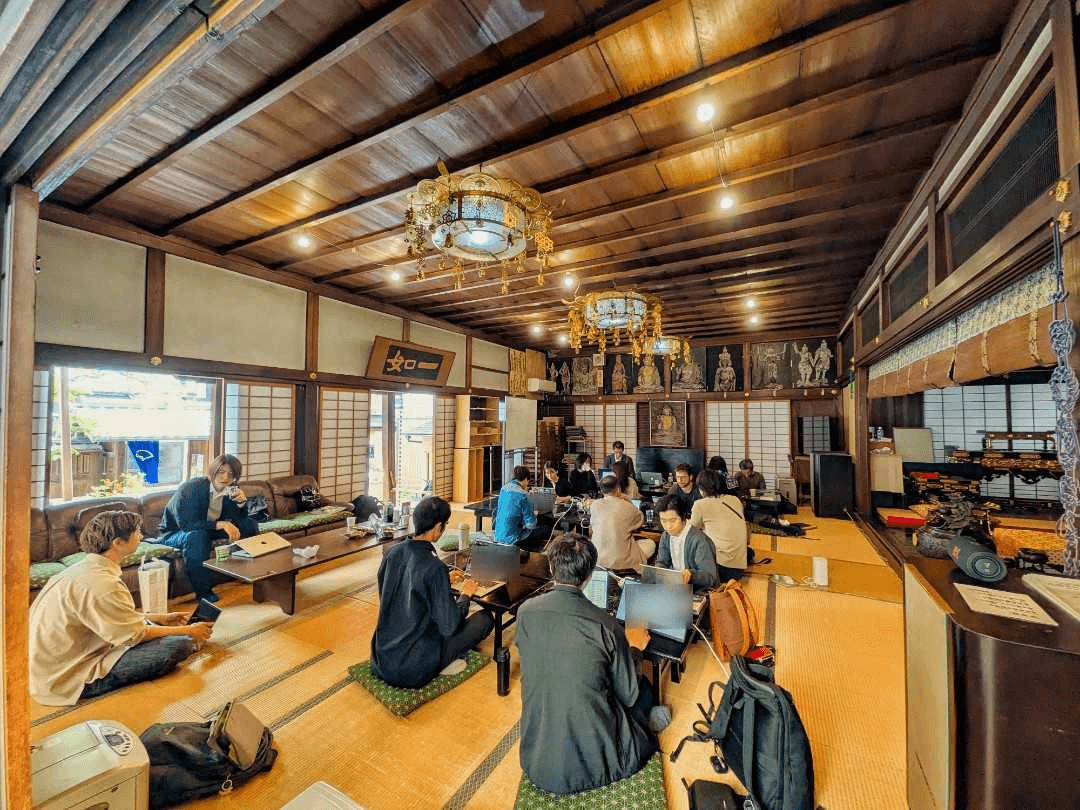
Miyako de IT holds mokumoku sessions once or twice a month at Kyoto venues including temples, traditional townhouses, coworking spaces, and university facilities. First-time and solo participants are welcome.
See the Kyoto mokumoku hub, current events, and event archive.
Conclusion
Mokumoku sessions are useful when the participant wants focused progress, light professional contact, or a recurring learning rhythm. They are less suitable when the real need is structured instruction. Define the objective, prepare one task, and allow repeated participation to reveal effects that cannot appear in a single visit.
Related articles
Kyoto Mokumoku Sessions: Temple Reports, Participation, and How to Find One
A hub for Kyoto mokumoku sessions, connecting participation guidance, the effects of repeated attendance, reports from temples and other venues, and practical answers based on 164 Miyako de IT events.
Designing an IT Study Group: Mokumoku, Reading, Lightning Talks, and Hands-on Formats
A guide for organizers choosing among four repeatable study-group formats and turning one into a monthly series, based on 7 years and more than 164 events in Kyoto.
How to Find and Choose IT Study Groups in Kyoto
A practical guide to finding IT study groups in Kyoto by starting from your goal: learn, make progress on your own work, give a short talk, or meet people. Current sessions live on the event listing, while community-by-community comparison lives on a separate Kyoto community guide.
Source data
The figures cited in this article are based on primary data in the Miyako de IT annual statistics report. It publishes yearly event counts, venue distribution, and event-format data.
Written by
Miyako de IT
Open event related to this article
 Waitlist
Oct 31 (Sat)
Original event title