
Five Reasons Offline Communities Still Matter
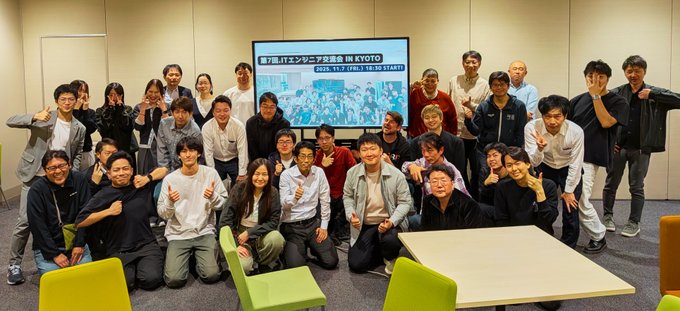
The amount you can learn online has grown. With technical articles, video, online courses, and generative AI, knowledge is available to one person working alone. Work proceeds while remote.
Even so, an in-person community keeps a role. Not because it is better than online. Because sharing the same place and time produces conversations that were not planned, reactions from the people present, and the context of a setting.
This article is for people deciding whether to attend something offline, and for people running such a setting. It sets out that role in five points, and states plainly what offline cannot solve. The conclusion first: the value of offline lies not in the volume of information but in the context that relationships acquire.
For the co-working session, the most common format, registration and the flow of the day are covered in the dedicated article, What is a mokumoku-kai? How to join and what happens on the day.
---
First: this is not an argument against online
What should be established first is that this is not a comparison in which one of online and offline ranks above the other.
Remote meetings, asynchronous document sharing, and casual conversation on Discord are the foundation of how work happens now. For people who find travel difficult, who are balancing childcare or family care, or who live far away, online is sometimes the easier way to take part.
What is written here is which kinds of thing are less likely to happen online alone. There is no need to choose one or the other.
---
Why in-person settings remain even where remote work is the default
Even after remote work became sufficient for getting the job done, in-person settings have not disappeared, because people do not gather only for the work.
When remote, points of contact do not occur automatically. Conversations that happened in a corridor or a break room at an office stop happening unless someone deliberately schedules them. An online meeting has its purpose fixed in advance, which structurally keeps out topics that sit outside that purpose.
An in-person setting works as a device for securing that outside. This is not a claim that remote work is bad. It is a claim that where points of contact are created has to be redesigned to fit how people now work.
Alongside hearing voices and seeing reactions in a shared setting, planning to travel to a venue, work there, and return home offers another way to consider a boundary in the day. Remote work and in-person contact covers the practical choices of contact and plans to go out that fit a remote-working routine.
Loneliness while working remotely is handled separately in Remote IT engineer loneliness and five countermeasures.
---
Reason 1: Conversation without an errand happens
Conversation online usually has its purpose fixed first. Asking a question, holding a meeting, being taught something, watching a talk. In each case the errand comes first.
In person, conversation without an errand arises during reception, breaks, moving around, and clearing up.
- "What are you building?"
- "Is this your first time at this venue?"
- "I heard about that technology at another event too."
These short exchanges sometimes lead to later questions, consultations, and joint programmes. They do not always lead there. Arriving with the assumption that attending produces a network sets up disappointment.
One more thing: forcing interaction has the opposite effect. Both time to work without talking and room in which to talk are needed. Miyako de IT co-working sessions are announced with work time and conversation time separated.
---
Reason 2: You can see what someone is interested in, and how strongly
Writing and profiles do not show how far someone's interest goes. In person, how they ask a question, where they hesitate, how much energy they bring, and what they are good at become visible.
This is not only about recruiting or sales. It provides information needed to improve how a community is run.
- Where beginners are getting stuck
- What a speaker wants to explore further
- What matters to the venue's side
- Whether a programme is asking too much
What becomes visible on the day arrives faster than a survey and at a finer grain. What is seen, however, is an impression rather than a measurement. When we use it in operating decisions, we check it against participant surveys and registration data.
---
Reason 3: Place creates memory and context
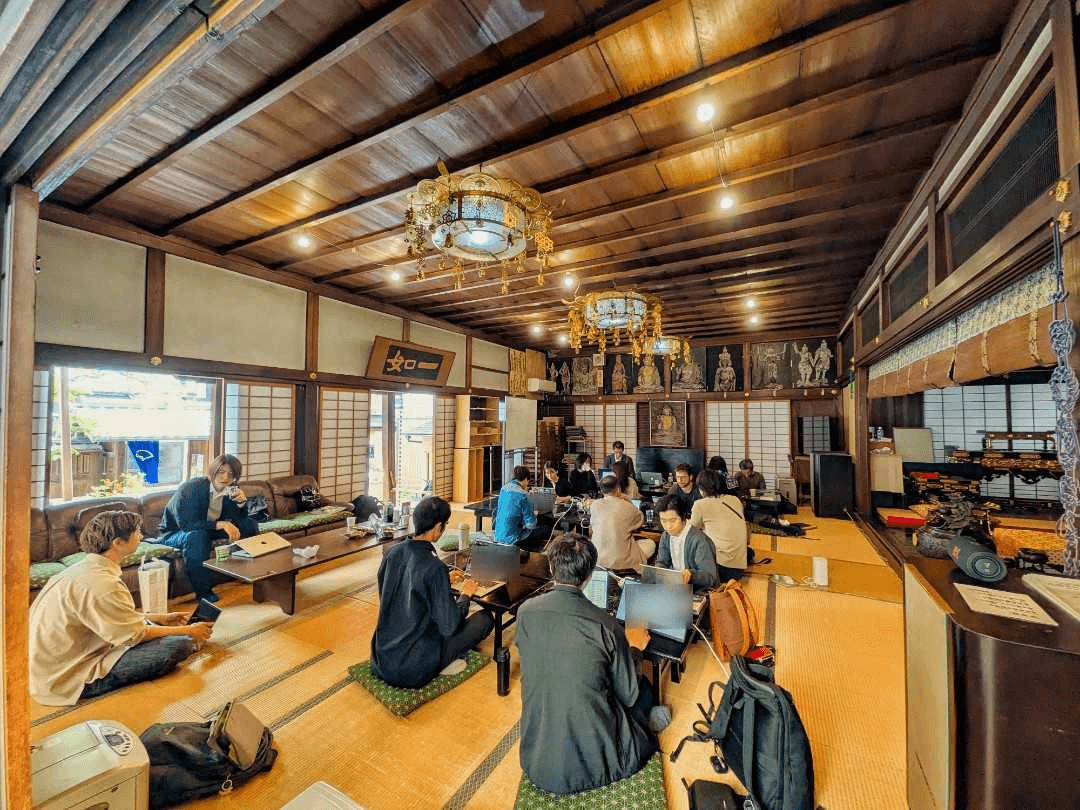
Miyako de IT has held events at temples, machiya townhouses, universities, public facilities, coworking spaces, and accommodation. In the Kyoto IT Community White Paper 2026, fixed as of July 17, 2026, the most common venue type is temples, followed by rental meeting rooms and event spaces, accommodation and exchange facilities, and coworking and technology hubs.
When the place changes, participants' behaviour changes. A quiet temple can make concentration easier; a machiya townhouse can make conversation more likely. A public facility makes the connection with the region easier to see, and a university makes research themes easier to bring in. These are observations from the organizing side, not the result of a controlled comparison.
We also avoid treating the novelty of a place as the value in itself. Access, facilities, cost, heating and cooling, whether photography is allowed, and the role of the regional side are checked each time before a venue is settled. How we work with a venue is set out in the Butsugenji case study.
---
Reason 4: Repeated involvement raises the resolution of a relationship
Trust does not come from one exchange of business cards. Meeting several times in the same setting is how you learn what someone is interested in and how they act.
In the Kyoto IT Community White Paper 2026, fixed as of July 17, 2026, 174 of 459 unique connpass registrants had registered for two or more events, and 109 for three or more. Registration does not indicate actual attendance, so it cannot be read as a number of visits. It does confirm that a setting people can stay involved with has held together.
The current operating scale of Miyako de IT is 164 events held over 7 years, with 647 connpass members. The breakdown and the counting method are on the community statistics page.
---
Reason 5: It builds relationships you can take back online
In-person and online are not opposed.
Once you have met someone, talking on Discord or social media becomes easier. The reverse also happens: you meet someone you knew online, then return online together. At Miyako de IT this movement back and forth happens routinely.
What matters is not fixing on a single setting but keeping a route by which a relationship can continue. Maintaining a state in which someone can come back after a period of not attending is part of the organizers' role.
---
What an offline community cannot solve
We will not present this as everything improving if you attend. Attending while holding excessive expectations leaves mainly the gap between them and what happens.
- Technical ability does not rise automatically
- Work or projects will not necessarily be found
- Deep personal relationships are not guaranteed
- It is not a place that treats loneliness or ill health. Where specialist support is needed, that comes first
- It is not a place that promises sales or recruiting results
As organizers we describe events on the basis that we do not promise these. Guidance for first-time participants is collected on the first-time guide. For anxiety before attending, For people who find study groups intimidating may also help.
---
Summary
The value of an offline community is not the volume of information.
- Conversation without an errand happens
- What someone is interested in, and how strongly, becomes visible
- Place creates memory and context
- Repeated involvement raises the resolution of a relationship
- A route back to online is created
Through these five, relationships gain a context that is hard to build online alone. Do not compel participation, let people choose how much they talk, and make it a place they can return to. That is the organizers' job.
We hold offline events in Kyoto every month. Dates are on the event listing. The format with the lowest barrier is the co-working session; what to bring and the flow of the day are in the guide to joining a co-working session.
Other participation guides and event reports are available in the article index.
Related articles
Kyoto Mokumoku Sessions: Temple Reports, Participation, and How to Find One
A hub for Kyoto mokumoku sessions, connecting participation guidance, the effects of repeated attendance, reports from temples and other venues, and practical answers based on 164 Miyako de IT events.
Remote IT Engineer Loneliness and Five Countermeasures
Loneliness in remote work is not a matter of personality; it can come from a way of working in which points of contact do not occur automatically. This article separates loneliness into five states and sets out countermeasures—scheduling time out of the house, settings where you choose how much you talk, somewhere to share technical work, a role outside your job, and separating out what needs specialist support—from the perspective of running a community in Kyoto for 7 years across 164 events.
Lessons from Running a Regional IT Community: What 164 Kyoto Events and 647 Members Showed About Continuing (2026)
A record of 7 years running a regional IT community in Kyoto, from 2019 to 2026. It sets out, year by year, what worked and what did not through launch, moving online, differentiating by place, and becoming established. The definition of the TEMPLE model is kept in its own article.
Source data
The figures cited in this article are based on primary data in the Miyako de IT annual statistics report. It publishes yearly event counts, venue distribution, and event-format data.
Written by
Miyako de IT
Open event related to this article
 Waitlist
Oct 31 (Sat)
Original event title