
Remote Work and In-Person Contact

While continuing to work remotely, where might you put contact that is not part of the job? This article sets out three perspectives for deciding whether to include in-person plans in your routine.
Online meetings and information sharing remain useful options. There may be periods when attending in person is difficult, or when online participation suits you better. There is no need to switch entirely to one or the other.
The scope here is creating points of contact that fit remote work. Five reasons offline communities still matter covers the general value of meeting in person. Remote IT engineer loneliness and five countermeasures covers different forms of loneliness and individual responses.
1. Include conversation beyond work-related business as an option
A scheduled meeting has an agenda. If you want to encounter topics outside work, you can consider separately where to create that contact.
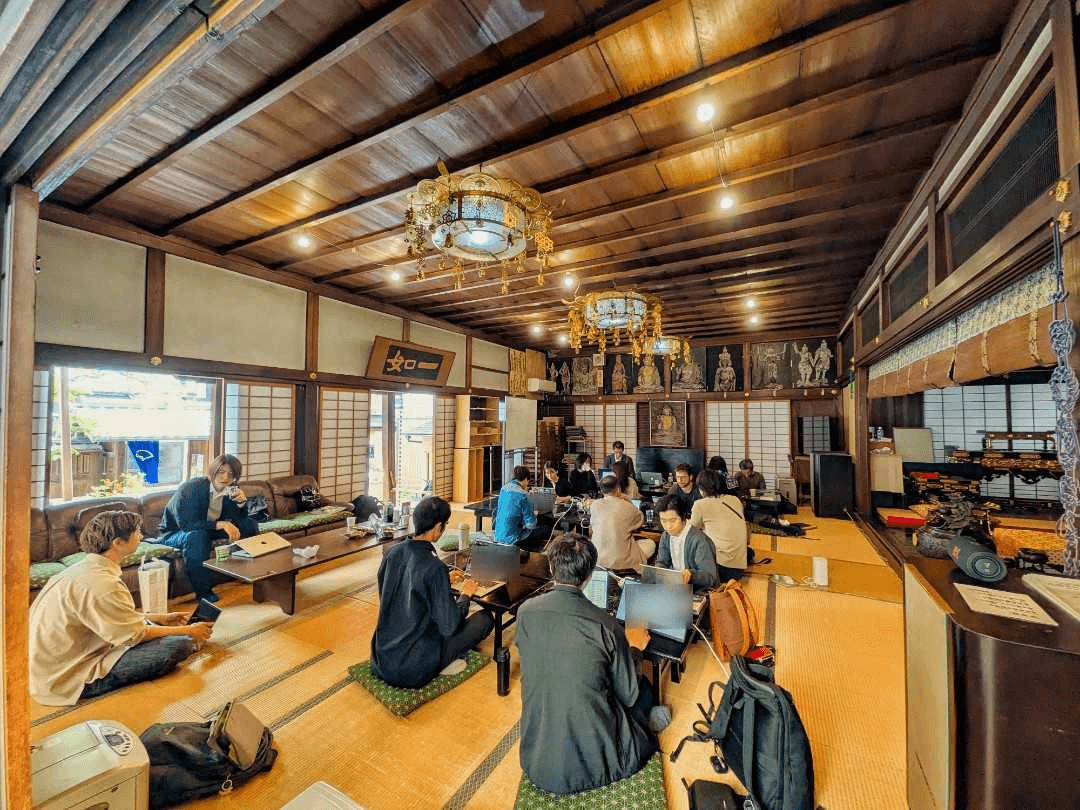
At an in-person study group, conversations outside the day's topic sometimes arise during breaks or clearing up. A mokumoku session is one format in which people bring individual tasks and spend time in the same setting. Attending does not, however, guarantee a discovery or a new professional connection.
The role of conversation without an errand is covered in more detail in the five reasons for meeting in person. Here, the starting question is whether you want a point of contact separate from everyday work messages.
2. Observe reactions in a shared setting
In person, you can receive tone of voice, facial expressions, and reactions to questions together with the circumstances in the room. Working at the same table or taking a break may offer cues different from written messages alone.
This does not mean that trust is impossible without meeting face to face. An impression formed on the day is also not enough to judge someone's ability or reliability. The idea is to combine online exchanges and in-person contact as needed.
How much conversation and involvement a session calls for depends on its format. Check whether it centres on conversation or individual work, and choose something that fits the effort you want to make.
3. Use a plan to go out as a boundary between work and home
If both work and rest take place at home, scheduling time outside offers one way to divide up the day. Travelling, working somewhere else, and returning home can form a planned sequence.
For example, you could include a study group or coworking session on a day that suits you. There is no single weekly or monthly frequency that everyone needs to follow. Consider travel time, cost, energy, and your workload, then choose a manageable range.
Going out or joining a community is not a promise to resolve loneliness or ill health. Responses to loneliness and the limits of what communities can address are covered separately in loneliness and five countermeasures.
Considering Miyako de IT as an option
Miyako de IT is an IT engineer community in Kyoto. It has held 164 events over 7 years, and its connpass group has 647 registered members (as of 2026-10-12). Registered membership is not a count of people who actually attended any particular session. The breakdown and counting method are on the community statistics page.
Use the event listing to reach each event page and check the format, date, venue, and participation requirements. Steps for a first visit are collected in the first-time guide.
Summary
Whether to add in-person contact to remote work can be considered through three questions: whether you want conversation beyond work, whether you want to observe reactions in a shared setting, and whether going out would provide a boundary in your routine.
There is no need to meet every aim at once. Keep online points of contact as well, and consider the options that fit your life now.
Participation guides and event reports are available in the article index.
Related articles
Kyoto Mokumoku Sessions: Temple Reports, Participation, and How to Find One
A hub for Kyoto mokumoku sessions, connecting participation guidance, the effects of repeated attendance, reports from temples and other venues, and practical answers based on 164 Miyako de IT events.
Remote IT Engineer Loneliness and Five Countermeasures
Loneliness in remote work is not a matter of personality; it can come from a way of working in which points of contact do not occur automatically. This article separates loneliness into five states and sets out countermeasures—scheduling time out of the house, settings where you choose how much you talk, somewhere to share technical work, a role outside your job, and separating out what needs specialist support—from the perspective of running a community in Kyoto for 7 years across 164 events.
Five Reasons New Graduate IT Engineers Should Join a Community
External communities fill gaps that internal training cannot. Drawing on experience with 647 members, this guide explains the value of joining study groups and mokumoku sessions from the first year of an engineering career.
Source data
The figures cited in this article are based on primary data in the Miyako de IT annual statistics report. It publishes yearly event counts, venue distribution, and event-format data.
Written by
Tomohiro Iida
Open event related to this article
 Waitlist
Oct 31 (Sat)
Original event title