
AI Agent Practice Lightning Talks
A special Miyako de IT session on practical AI tools and workflows.
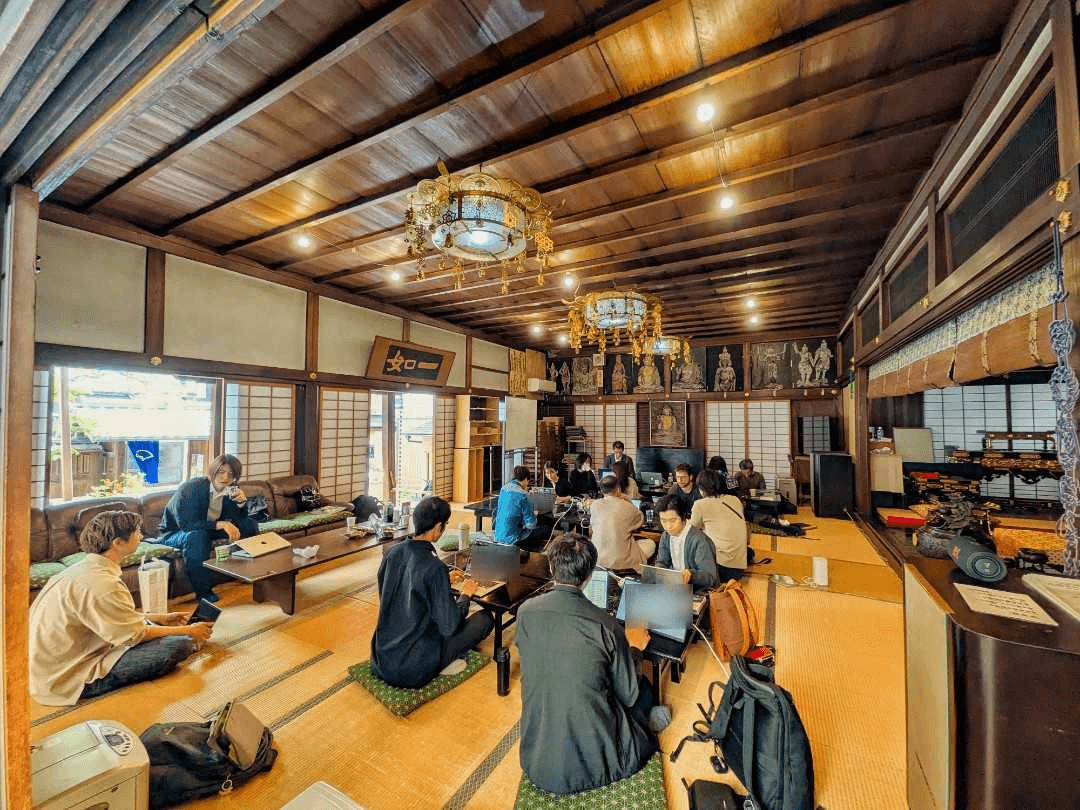
AI Agent Practice Lightning Talks at the Former Kyoto Prefectural Assembly Hall
On May 30, 2026, Kyoto IT engineer community Miyako de IT held its special edition, “AI Agent Practice Lightning Talks,” at the Former Assembly Hall in the Former Main Building of the Kyoto Prefectural Government.
The theme was practical use of AI agents and generative AI. Participants shared examples involving Claude Code, OpenClaw, Codex, Cursor, ChatGPT, GitHub Copilot, local LLMs, multi-agent systems, and AI design tools—tools that are changing day-to-day development and work.
The historic assembly hall created a different setting from an ordinary IT event. In a distinctly Kyoto atmosphere, participants discussed AI, development, operational improvement, ways of working, and regional revitalization. About 30 people attended, including Kyoto Prefectural Government staff. Approximately 90% of post-event responses were “satisfied” or “very satisfied,” indicating strong interest in the practical use of AI agents and generative AI.
We also thank Miyako de IT operations member Tatsuoka for dedicated support with venue operations, participant assistance, and on-the-day facilitation. Events depend not only on presentations but on an operating structure that lets people participate with confidence and focus on presenting and exchanging ideas.
Lightning-talk themes and practical examples
The talks covered practical themes: using AI agents to make social-media operations more efficient; using generative AI in preparation for selling a karakuri-kit product; keeping a daily work log; using local LLMs for operational efficiency; creating templates that improve document-production speed without reducing quality; and building and using multi-agent systems.
Participants also discussed design creation with Pencil and Claude Design, using AI to expand one’s own capability, and using AI vibe coding to energize Kameoka. The talks connected personal workflows, product work, and regional activity.
From trying AI to integrating it into work
A common point across the presentations was that AI should not end at “I tried it.” The question is how to embed it in work, production, and regional activity. AI does not automate everything. Teams need to decide which tasks to delegate, where people must check results, and how to increase speed without lowering quality.
One presentation on document efficiency described completing a template and structure first rather than asking AI to create everything from scratch. This preserved the quality of deliverables while reducing preparation time. The approach can apply beyond engineers to sales, planning, public relations, and community operations.
AI design tools change the starting point for making things
Presentations on Pencil and Claude Design showed how AI design tools are changing the entry point to production. Initial landing-page ideas, advertising creatives, sales materials, and event-announcement images have often required design experience or coordination with an outside provider. With AI design tools, people can make an idea visible immediately and improve it while looking at the result.
This is not only for engineers and designers. Community organizers, independent makers, people active in a region, and people starting a business can use AI to shorten the distance between an idea and a visible form.
Reframing learning and work in the AI era
The theme “I want to become stronger by using AI fully” was emblematic of how learning and work can be reframed. Using AI is not only about making work easier. It can help people organize thought, work faster, increase the number of experiments, and broaden what they can do.
Keeping a daily work log is similarly important for knowledge management in the AI era. Recording work, insights, decisions, and improvements makes later AI-assisted organization and reflection possible. This supports not only individual productivity but also team knowledge sharing and operational improvement.
Implementation expands to local LLMs and multi-agent systems
The local-LLM and multi-agent presentations showed AI use moving toward implementation. In addition to cloud AI such as ChatGPT, more people are integrating AI for their own environment and work. Development support, operational automation, internal knowledge search, inquiry handling, and document production are likely to become increasingly common themes.
AI vibe coding in Kameoka
A presentation on energizing Kameoka through AI vibe coding was especially characteristic of Miyako de IT. AI vibe coding is a style of development in which people talk with AI while turning ideas into code or prototypes. It may enable small regional ideas—event pages, tourism guides, local information, and resident-participation services—to take form quickly.
This possibility extends beyond Kyoto City to places including Kameoka and other parts of Kyoto Prefecture. The session suggested that a Kyoto IT community can connect learning and exchange with projects that actually move a region forward.
Kyoto Prefecture’s AI-agent work and public-sector initiatives
The event also introduced Kyoto Prefecture’s initiatives related to using AI agents. Generative AI and AI agents are important issues in government as well, with possible applications in administrative procedures, operational reform, data use, and improved resident services. Accuracy, information management, and operating rules are necessary alongside that potential.
That is why it matters for public servants, engineers, businesses, students, and creators to talk in the same place. An opportunity for government and the regional community to discuss AI use together can help build the groundwork for IT and AI practice in Kyoto.
The place of this Miyako de IT special edition
The session brought together AI agents, generative AI, local LLMs, AI design, vibe coding, and regional revitalization. Its value was not only technical discussion, but time for participants to ask how work can change, what can be built locally, and how far AI can take an idea.
The event was made possible by speakers, participants, Kyoto Prefectural Government staff, and the members who supported operations. Miyako de IT will continue to hold events where people interested in IT, AI, web development, and blockchain can connect, learn, and practice in Kyoto.
Related articles
- Introduction to Creating Video with AI — a learning-event report on tool differences, prompt design, and commercial-use cautions.
- Claude Code and OpenClaw Hands-on Report — a hands-on comparison after actually setting up both tools.
- Quantum Mechanics for IT Engineers #1 — a report from the first session in a three-part quantum-computing series.
- What is Miyako de IT? — an overview of the community, its activity policy, and how to participate.
Related articles
Exploring Our Relationships with AI: Tonari no AI-san Workshop Report | Kyoto
On August 28, 2026, Miyako de IT held Tonari no AI-san at Taisho University Kyoto Academia. Participants shared how they relate to the AI they use every day, then let those AIs react to the descriptions.
What an IT Study Group Is Worth in the Generative AI Era: From Being Taught to Bringing Back Results
Generative AI has lowered the cost of obtaining technical information, so where does the value of an IT study group sit now? Drawing on Miyako de IT's own sessions in Kyoto on Claude Code, AI agents, AI video generation, and quantum computing, this article examines the shift from a place to be taught toward a place to bring back what people actually tried.
How to Make an AI-Agent Lightning Talk Verifiable: A Public PASS–FAIL–PASS Demo on One Slide
A reproducible AI lightning-talk demo example with public Agent Role Contracts inputs, an intended failure, historical CI, and explicit limits.
Source data
The figures cited in this article are based on primary data in the Miyako de IT annual statistics report. It publishes yearly event counts, venue distribution, and event-format data.
Written by
Miyako de IT Editorial Team
Open event related to this article
 Waitlist
Oct 31 (Sat)
Original event title