
How Municipalities Can Work with IT Talent Communities: Lessons from Kyoto
How Municipalities Can Work with IT Talent Communities
Municipalities and regional organizations often need better contact with engineers, while independent IT communities need stable venues, public credibility, and connections beyond their existing members. A partnership can serve both sides when it is designed as an ongoing relationship rather than a one-off event.
This guide draws on Miyako de IT's work with Kyoto Prefecture's IT Industry Promotion Working Group, Taisho University Kyoto Academia, and Kyoto Chiesangyo Sozonomori.
1. Why municipalities work with IT communities
Make regional IT talent visible
Engineers working remotely, independently, or inside local companies are often invisible to public-sector programs. A continuing community creates repeated contact and makes skills, interests, and local activity easier to understand without constructing a new database of individuals.
Connect migration and long-term regional relationships
Technology workers who move to or repeatedly visit a region need professional and social contact. Community events can provide a low-pressure entrance that complements formal migration support.
Develop a practical DX talent pool
A community is not a staffing agency, but continuing contact can reveal people able to advise on proofs of concept, public-service design, security, data, and implementation. The relationship should not be described as guaranteed procurement or recruitment.
Create contact among universities and companies
Regional communities can connect students, researchers, employers, founders, and public officials who would otherwise meet only through separate institutional channels.
2. Four partnership models
1. Venue provision
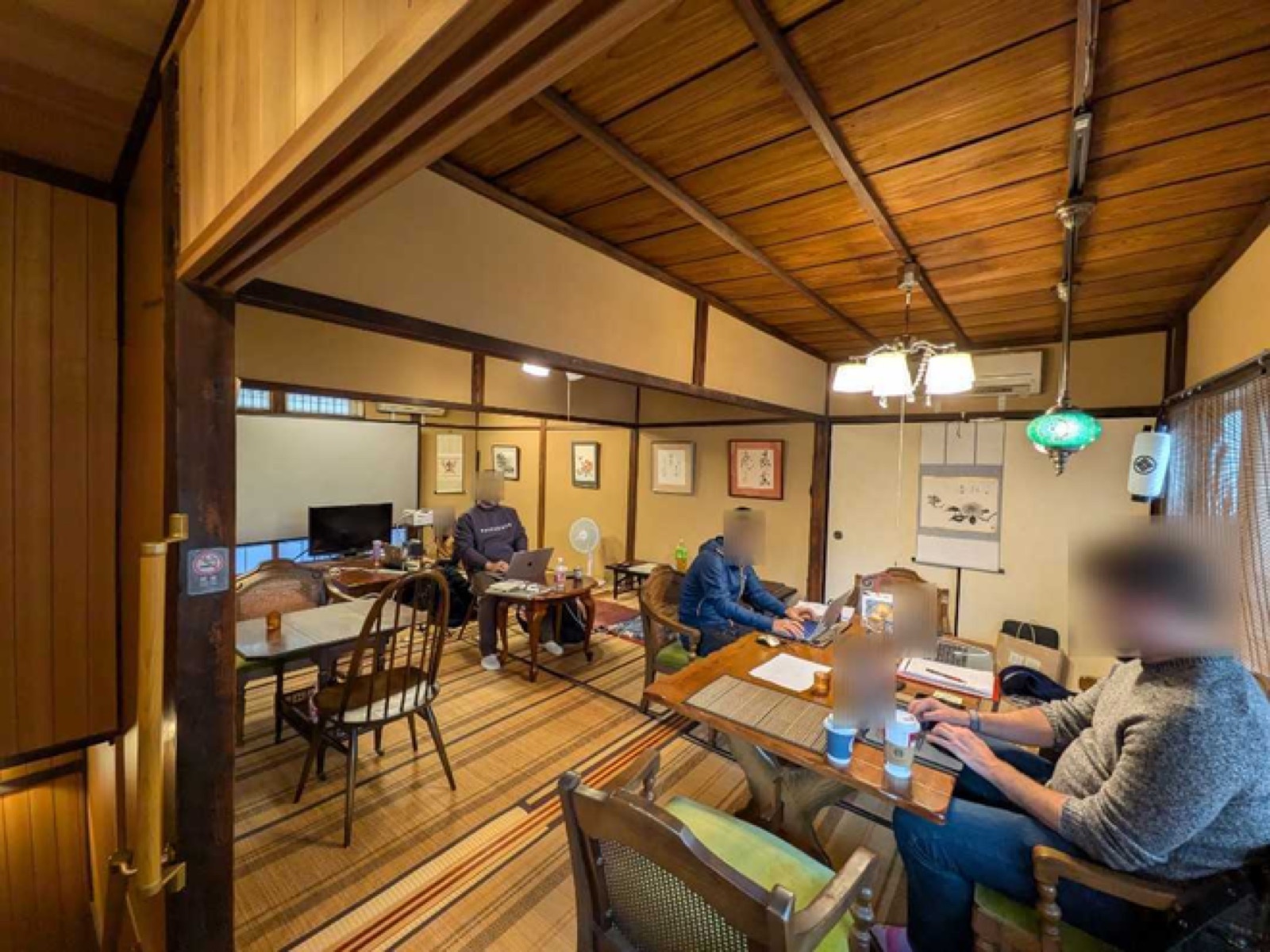
A municipality or partner can provide a public facility, former school, traditional townhouse, or similar space. The useful contribution is not only the room: clear booking rules, equipment information, and a repeatable path to future use matter.
2. Co-hosted events
Joint study sessions or networking events combine a municipality's reach with a community's relationships and operating knowledge. Responsibilities for recruitment, facilitation, privacy, and follow-up should be explicit before announcement.
3. Participation in working groups
Community operators can bring observations from engineers into industry-promotion and DX discussions. Their role should be to contribute field evidence, not to claim that every participant shares one opinion.
4. Migration and company-attraction programs
Events can connect prospective residents, regional companies, and people already working remotely in the area. Success depends on continuing contact after the introductory event.
3. Kyoto examples
Kyoto Prefecture IT Industry Promotion Working Group
Miyako de IT participates in the working group on an unpaid basis, contributing observations from continuing community operations. This is an example of working-group participation rather than event outsourcing.
Taisho University Kyoto Academia
The university facility has hosted learning events and created contact with an educational institution. The relationship combines venue use with an academic context while keeping the community responsible for event operation.
Kyoto Chiesangyo Sozonomori
Collaboration with the organization and its KOIN innovation hub creates contact with Kyoto industry, startups, and regional programs. It illustrates partnership with an economic and industry-support body.
Distinctive venues
Temples, university facilities, and other locally meaningful places can create an experience unavailable in a generic meeting room. The venue should still be accessible, affordable, and operationally sustainable.
4. Five steps for beginning collaboration
Step 1: define the purpose
Choose the primary objective: talent visibility, learning, migration, DX, company contact, or another measurable problem. Do not combine every policy goal into one event.
Step 2: contact an existing community
Review its event history, participant audience, Code of Conduct, and operating continuity. Approach it as a potential partner, not as a free list of engineers.
Step 3: understand actual operations
Discuss organizer workload, venue needs, participant privacy, communication channels, and what has or has not worked previously.
Step 4: design a small co-hosted program
Agree on responsibilities, decision-makers, costs, promotion, data handling, and the path to a second event before launching the first.
Step 5: hold, continue, and measure
Use indicators appropriate to the purpose: repeat attendance, participant mix, introductions continued after the event, prototypes, or follow-up meetings. Attendance alone rarely captures the result.
5. Failure patterns and prevention
Ending after one event
A single event creates temporary visibility but little infrastructure. Agree in advance on review timing and the next possible contact.
Underestimating operating work
Recruitment, inquiries, accessibility, facilitation, photography, consent, and follow-up all require ownership. A venue and a budget do not replace operations.
Treating subsidy expenditure as the purpose
Funding can support a useful program, but activity designed only around a funding deadline tends to stop with the grant. Begin with the regional problem and add funding where it helps.
Mixing talent development with immediate DX delivery
Learning and relationship-building operate on a different time scale from procurement and system delivery. Define them separately and make any commercial relationship transparent.
6. Using grants appropriately
Potential funding may support venues, accessibility, travel, facilitation, and documentation. Eligibility and procurement requirements vary, so municipalities and partners must check the applicable program. A community should not promise that a particular grant will apply.
7. Regional partnership in the TEMPLE model
The L for Local dimension of Miyako de IT's TEMPLE model treats external partnership as a continuing operating category. The objective is a circulation of trust, people, places, and opportunities while preserving the community's independent purpose.
8. Conclusion
Municipal-community collaboration works when both sides define a narrow purpose, respect their different roles, begin with a manageable program, and design continuity before the first event. Venue provision, co-hosting, working-group participation, and migration programs can be combined according to regional conditions.
Related articles
Exploring Our Relationships with AI: Tonari no AI-san Workshop Report | Kyoto
On August 28, 2026, Miyako de IT held Tonari no AI-san at Taisho University Kyoto Academia. Participants shared how they relate to the AI they use every day, then let those AIs react to the descriptions.
How Researchers Can Find IT Engineers: Seven Routes to Collaboration
Seven practical routes for researchers seeking IT engineers before an industry collaboration or proof of concept, based on seven years and 164 Miyako de IT events.
Kyoto Report Session on Winning Hashed's Protocol Camp Hackathon in Korea
On May 18, 2026, Miyako de IT hosted a participant report on Protocol Camp, a blockchain bootcamp in Korea supported by Hashed. A member of the winning hackathon team shared a first-hand example of connecting Kyoto with the international Web3 ecosystem.
Source data
The figures cited in this article are based on primary data in the Miyako de IT annual statistics report. It publishes yearly event counts, venue distribution, and event-format data.
Written by
Tomohiro Iida