
The language link ran one way
Fixing three Japanese pages and verifying hreflang on six
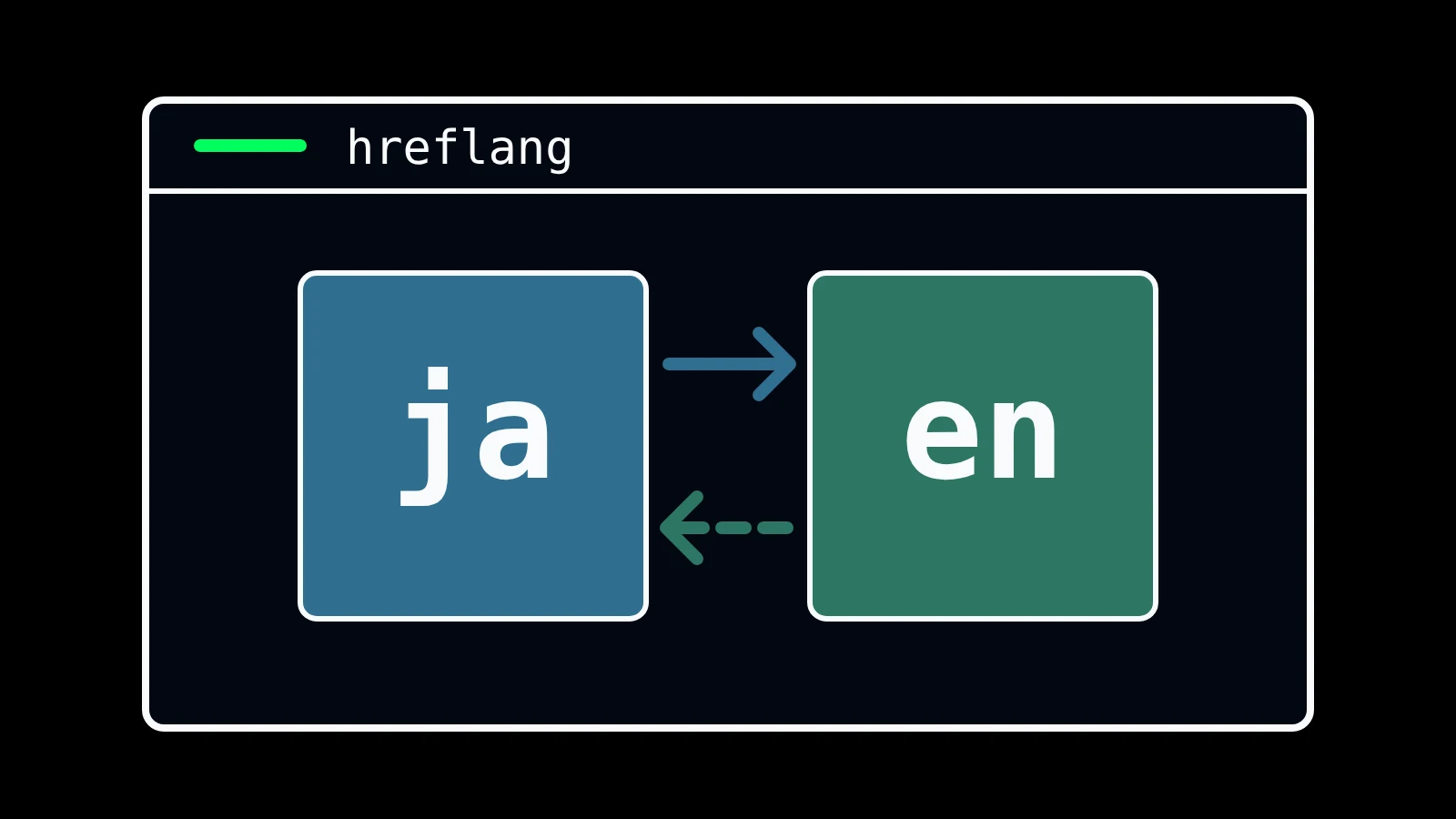
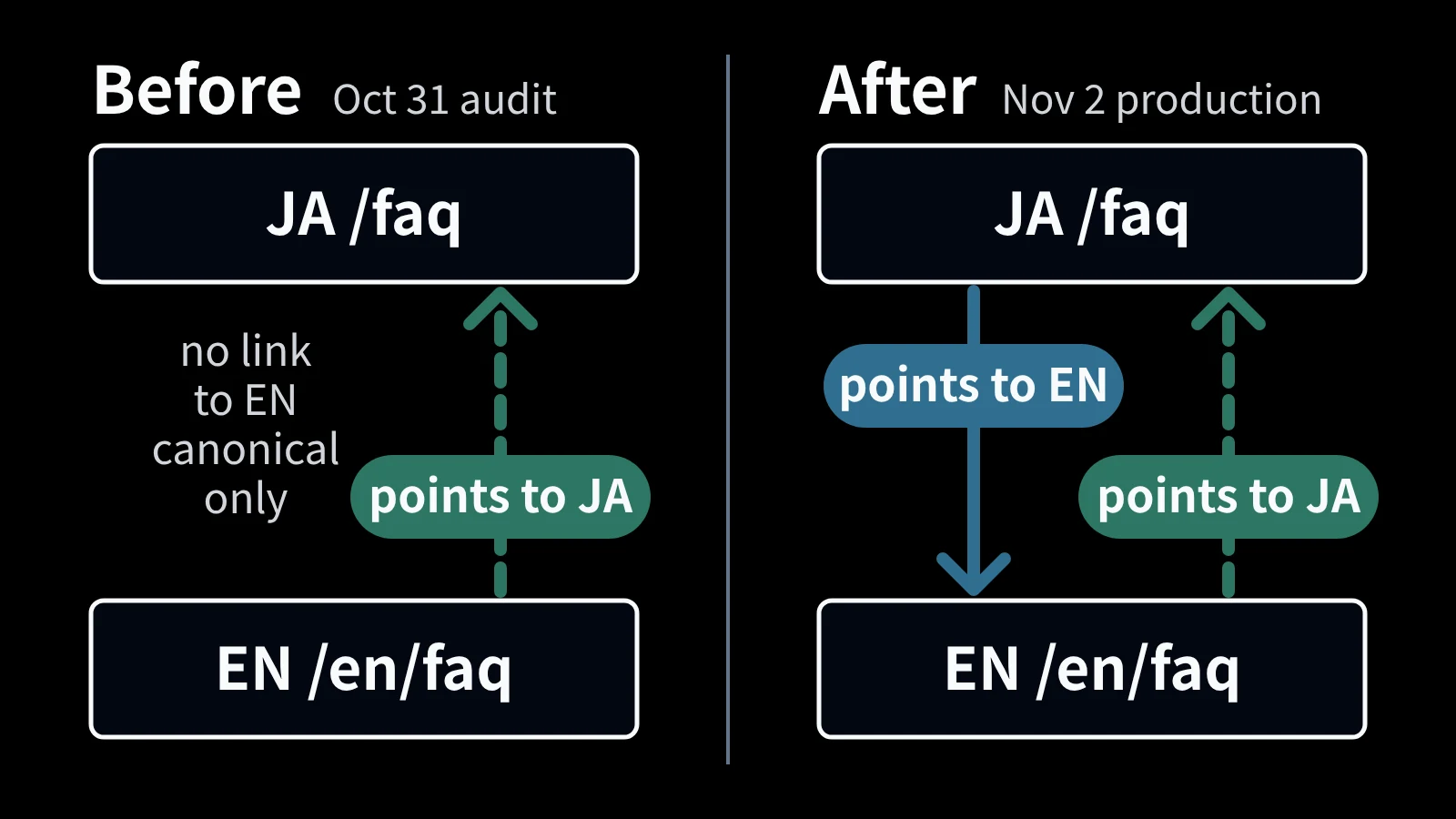
The Miyako de IT website has English pages that pair with its Japanese pages. The hreflang annotations in each page's HTML head are what tell search engines about that pairing. An audit on October 31, 2026 found that five Japanese pages were not emitting them. This article covers the three that were fixed. The English pages pointed to their Japanese counterparts, but the Japanese pages did not point back. The language relationship ran one way only.
This is a record of how we confirmed the problem, what we changed and what we checked in production. The change is PR #382, released to production on November 2, 2026. We have not yet measured any effect on search traffic or participation.
How it was found
It surfaced during a check of public pages in Issue #349, where we track our search-related work. On October 31 we fetched 22 key Japanese and English URLs again. All returned HTTP 200 and all had a title and description. However, five Japanese pages had zero hreflang links in the head, while each of their English counterparts emitted three.
PR #382 fixed three of those pairs:
| Japanese page | English page |
|---|---|
| /sponsor | /en/sponsor |
| /faq | /en/faq |
| /guides/kyoto-mokumoku | /en/guides/kyoto-mokumoku |
The English side emitted ja, en and x-default; the Japanese side emitted only a canonical. For the same pair, only one side said "there is a matching page." The site's i18n design also prohibits one-sided hreflang.
The cause: metadata written directly on each page
The site has a shared function, buildAlternates (lib/i18n/metadata.ts), that builds the canonical and hreflang together. The English pages went through it. The three Japanese pages, however, still used an older pattern that wrote only the canonical directly.
The function works like this:
- It builds the absolute Japanese and English URLs and uses the URL for the language being shown as the canonical
- If the site-wide English publication flag is off, or the route has not passed English quality checks, it returns only the canonical
- When the publication conditions are met, it returns ja, en and x-default, with x-default set to the Japanese URL
Because the decision about whether a pair may be published lives inside the function, pages never need to write hreflang by hand. Only the pages that wrote their metadata directly sat outside that decision.
The same change in all three files
The fix replaces the metadata on the three Japanese pages with the shared function. This is the change on the FAQ page (excluding the added import line):
- Before alternates: { canonical: "https://www.miyakodeit.com/faq" },
- After ...buildAlternates("/faq", "ja"),
/sponsor and /guides/kyoto-mokumoku received the same replacement with their own paths. Body text, CSS, CTAs, titles, descriptions, OGP and structured data were not changed. The PR touched six files in total; the other three are a regression test, a visual-review record and a LEARNINGS entry recording what was learned.
A test that reads the real page definitions
The regression test (__tests__/lib/reciprocal-hreflang.test.ts) does not just exercise the shared function. It loads the metadata that each Japanese and English page file actually exports. Even if the function is correct, the bug remains if a page does not use it.
It checks two conditions per pair, six cases across the three pairs:
- With English publication ON, the Japanese page and the English page each emit their own canonical and exactly the same set of ja, en and x-default
- With English publication OFF, both emit only their canonical
When the Japanese sources were reverted to their pre-fix state and the same test was run, the three publication-ON cases failed because hreflang was missing, and the three OFF cases passed. After the fix, all six cases pass. Using an input that fails confirmed that the test can actually detect this bug, rather than simply passing.
Checks in production
PR #382 was accepted in this order:
| Stage | Result |
|---|---|
| Regular CI (run 41388441020) | SUCCESS. Includes types, unit tests, i18n, design, built header regression and the rendered events audit |
| Formal independent QC | PASS. Zero findings |
| Merge | Squash-merged at 13:34:22 JST on November 2, 2026 |
| Production HTML (13:36:25) | All six Japanese and English URLs returned HTTP 200, one self-referencing canonical each, ja, en and x-default matching in both directions, no noindex. 6/6 PASS |
| Production event-display audit | pnpm audit:events:production exited with code 0 |
| Post-release community-stats consistency CI (run 41389308221) | SUCCESS |
An HTTP 200 alone is not evidence that a change is live. We read the canonical and hreflang actually emitted in the head of all six URLs.
What we do not know yet
What has been confirmed covers the implementation, the tests, CI, independent QC and production HTML. These remain unknown:
- When and how search engines will act on this relationship
- Whether search impressions or clicks, or participation and inquiries arriving via English pages, will increase
We plan to compare equal-length periods after release, and we do not count any of these as results of this fix.
The October 31 audit also found zero hreflang links on the Japanese /first-time and /contact pages. Those two pages were outside the scope of PR #382, and in the main-branch source as of November 2, 2026 their Japanese side still emits only a canonical. Their English side goes through the shared function, so the same one-way relationship remains. That will be handled as separate work.
Finding the same bug on your own site
If your site has English versions, these steps will find the same one-way relationship:
- Fetch the HTML of both the Japanese and the English page and count hreflang links in the head. If only one side has zero, the relationship is one-way
- Search for places where canonical or hreflang is written directly on individual pages, and move them to a shared function
- Make tests read the actual page definitions, not just the shared function, and confirm they fail when the fix is reverted
Miyako de IT publishes records of site-improvement work like this. If you are working on something similar, find a mokumoku session in the event list and bring the next step of your work.
Related articles
What AI-assisted website improvements taught us about gaps in passing tests
A real Miyako de IT website case: price conditions lost in translation, incomplete HTML extraction and Japanese wrapping, followed through fixes, tests and production checks.
Search Traffic to a Community Site: Bing Was Contributing Too
Search traffic to a community site does not come only from Google. When Miyako de IT measured GA4 on July 24, 2026, Bing organic search produced 68 sessions in the prior 90 days—about one tenth of Google for the same period. This report records that observation, AI referrals, and why we publish the numbers without claiming causation.
How Search Clicks Grew About 11× in Six Months after We Turned a Member Site into a Publishing Site
A first-party operating log from six months of publishing on miyakodeit.com. Search clicks rose from 17 in January 2026 to 183 in June, while impressions grew about 35× from the first measured month. The article also records measurement and causality limitations.
Source data
The figures cited in this article are based on primary data in the Miyako de IT annual statistics report. It publishes yearly event counts, venue distribution, and event-format data.
Written by
Miyako de IT Editorial Team
Open event related to this article
 Registration open
Nov 4 (Wed)
Original event title