
Connecting with International IT Engineers: Joint Events with Digital Nomad Kyoto

Walking through Kyoto, you increasingly see visitors working with laptops open. Many are “digital nomads”—IT engineers and creators who earn a living through remote work while traveling around the world without being tied to one place.
Miyako de IT, Kyoto's IT-engineer community, holds joint events with the international digital-nomad community Digital Nomad Kyoto, creating opportunities for international exchange among IT engineers.
Why digital nomads choose Kyoto
- Cultural appeal: Shrines and temples with more than a thousand years of history, and traditional machiya architecture
- Strong infrastructure: High-speed Wi-Fi and reliable public transportation
- Safety and cleanliness: An outstanding level of public safety by global standards
- Food culture: High-quality food ranging from Kyoto cuisine to affordable set meals
What is Digital Nomad Kyoto?
Digital Nomad Kyoto is a project that combines Kyoto's traditional culture with modern life and helps create an environment where digital nomads can stay and work comfortably.
What the joint events are like
- Languages: Japanese and English
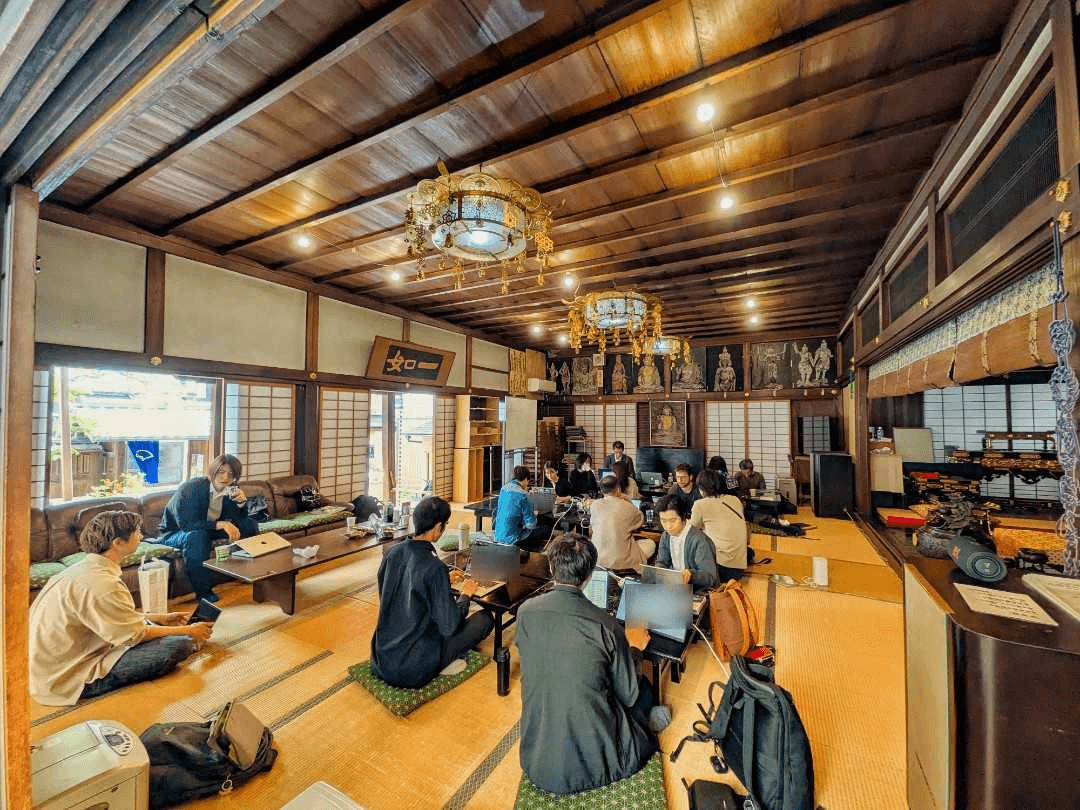
- Format: Co-working study session plus networking time
- Venue: Primarily Butsugenji Temple
Some people worry about the language barrier, but programming languages and technology are shared across borders. If you show someone your code and ask, “What do you think?”, communication can work even when neither person's spoken language is perfect.
Topics that can come up at a co-hosted event
The following is neither the result of measuring change in participants nor a record of what organizers logged at individual editions. These are topics that can come up when you sit alongside people who have come from abroad.
1. Ways of working you would not otherwise meet: European approaches to work and how startups run elsewhere can become ordinary chat between participants. 2. Technical topics carry a smaller vocabulary load than everyday conversation: Because the terminology is shared, this is a subject on which conversation tends to work even when someone is not confident in English. We have not measured whether anyone's language ability improved. 3. You meet people who keep moving: Digital nomads travel. Someone you meet in Kyoto may be in another country the following month. We have not confirmed whether this led to employment, contracts, or joint development.What to prepare before your first visit
Preparing something to talk about matters more than preparing your English.
- Be able to name one thing you are working on — "I'm using React right now" or "I'm learning Rust" is enough to start a conversation
- Have something you can show on screen — unfinished work is fine. Showing code or an app halves the explaining
- Prepare a three-sentence introduction — your name, your work, and what you are currently interested in. Nothing more is needed
- Check power and Wi-Fi — the co-working format runs for several hours, and a dead battery leaves you with nothing to do
Keeping a translation app open is also useful. There is no need to feel awkward about using one.
How the day runs
A bilingual session usually follows this shape.
1. Check-in and introductions — one round in both Japanese and English. Your name, and one line on what you are working on
2. Focused work time — everyone works on their own task. There is no conversation here
3. Break and networking — showing each other screens, or asking about something you are stuck on
4. Sharing results — a short report on what you did. Things that did not work are also worth sharing
Conversation is only required in steps 3 and 4. This is not a session where you speak English continuously, which makes it approachable if you are not confident in the language.
Running a bilingual event: notes from the organiser side
- Write the announcement in both languages from the start — overseas participants cannot apply to a Japanese-only listing. Add both at the outset rather than translating afterwards
- Show the way to the venue in photos — an address alone will not get someone unfamiliar with the area to the door, particularly when the venue is a temple or a machiya
- Make the schedule boundaries explicit — when languages mix, a vague transition leaves participants unsure what to do. Announce the start, break, and sharing times in advance
- Decide the order of sharing beforehand — "whoever wants to go first" is hard to act on in a second language. A fixed order gets everyone speaking
Common worries, and what actually happens
"Can I take part if I do not speak English?" — In what we have seen while running these sessions, participants who do not speak English as a first language also attend. Stringing words together is enough for a conversation to work. "Will I stand out if my technical level is low?" — In a co-working format everyone works on their own task, so levels do not need to match. People who are still learning attend. "Is it all right to come alone?" — Some people do come alone. Because introductions are built into the schedule, the organisers provide the first opening.If your organization is considering co-hosting
This article covers preparation for attending. The split of roles, the definition of the attendance figures, and the items that remain unconfirmed are set out in the Digital Nomad Kyoto co-hosting case.
Conclusion
As globalization and remote work spread, the world of IT engineering is becoming increasingly borderless. Since its launch in 2019, Miyako de IT has brought together more than 647 members and held more than 164 events. Come experience a Kyoto IT-engineer community connected to the world.
Related articles
15 Active IT Engineer Communities to Join in 2026
A catalog of 15 communities for IT engineers—nine nationwide and six regional. Compiled from 7 years and 164 events of community operations in Kyoto, it covers choosing by learning, networking, speaking, or region; four steps to a first visit; and common questions. This is not an exhaustive nationwide list. The order is not a ranking, and each community's activity was checked against primary sources such as official sites and connpass.
The Complete Guide to IT Engineers in Kyoto: Salaries, Career Changes, Work Styles, and Communities (2026 Edition)
A guide to working, changing jobs, and learning as an IT engineer in Kyoto. Drawing on more than 7 years of operating an IT engineer community in Kyoto, this page organizes the whole local IT landscape: major company categories, salary levels, the job market, career paths, communities, work environments, and places to live.
Changing Jobs as an Engineer in Kyoto (2026): Process, Major Agents, Application Routes, and U/I-Turn Support
How to go about changing engineering jobs in Kyoto, organized around the Kyoto coverage of the major recruitment services, five application routes, routes for people without experience, and U/I-turn support, using official information from public bodies and from each company. We do not rank the services; we state the intended users, the areas covered, the main roles, the verification date, the cost, and the official URL. Salaries by role have been moved to a separate salary guide. Written from the perspective of the Kyoto IT engineer community Miyako de IT (7 years, 164 events, 647 members).
Source data
The figures cited in this article are based on primary data in the Miyako de IT annual statistics report. It publishes yearly event counts, venue distribution, and event-format data.
Written by
Tomohiro Iida
Open event related to this article
 Waitlist
Oct 31 (Sat)
Original event title